








Light Knows What We Miss
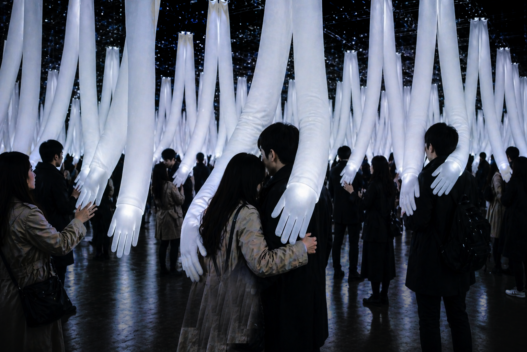
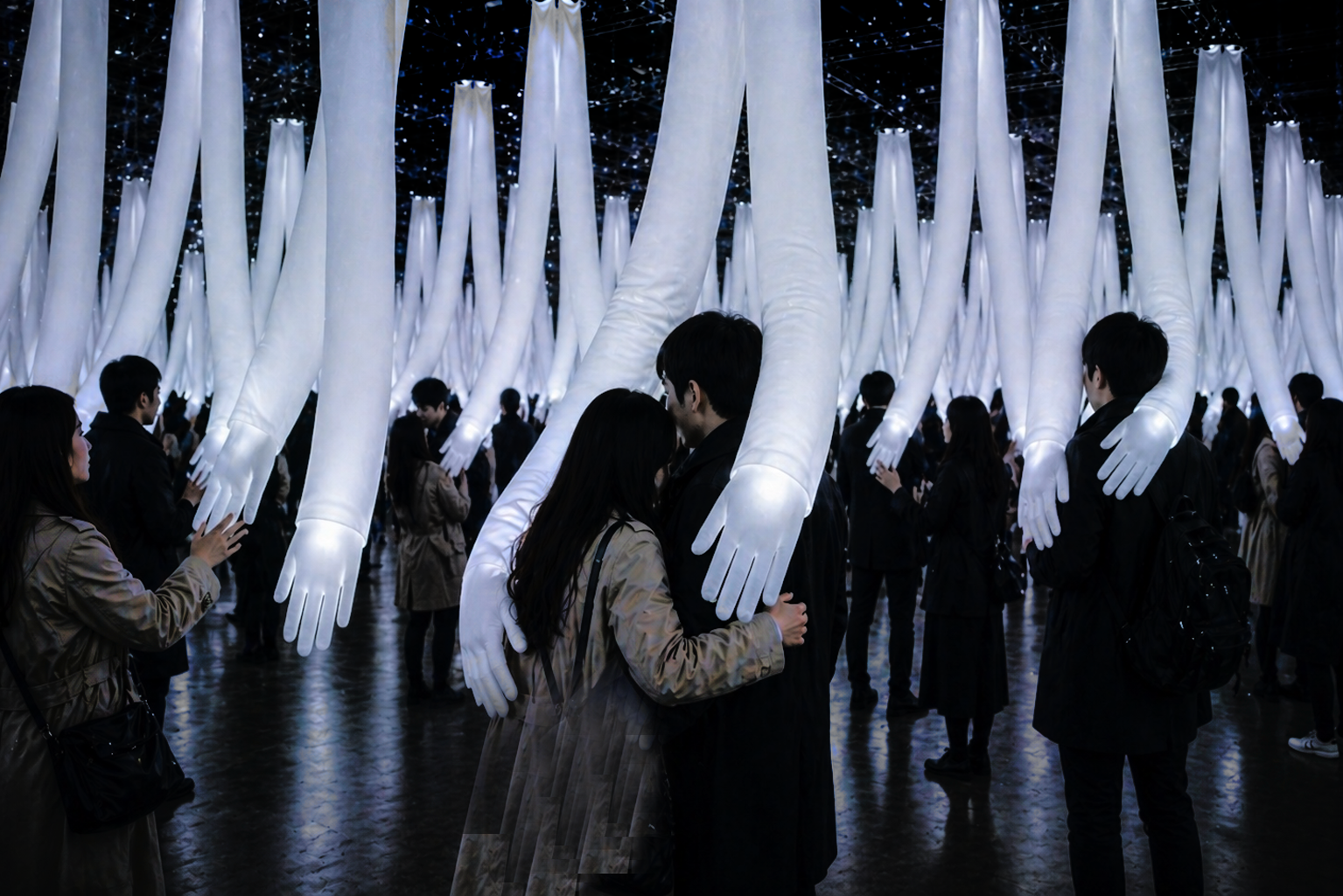
There is a particular difficulty in discussing Caressing Zone strictly as a lighting work, because the project deliberately places light in a supporting role. The first thing a visitor encounters is not illumination, but a strange occupation of space. Hundreds of suspended arms descend from above like a weather system that has taken physical form. The installation does not announce itself through brightness, spectacle, or technological virtuosity. Its presence emerges gradually through movement, proximity, and touch. Light enters the experience almost quietly, yet it is the element that allows the entire fiction of the work to remain believable.
Before illumination is introduced, the object itself is remarkably simple. A sewn textile sleeve, stretched at one end and left free at the other, hangs in space with very little structural ambition. The arm is not sculpted with anatomical precision. It avoids realism. Without light, it would likely read as a suspended textile form, curious perhaps, but incomplete. The lighting strategy provides the condition through which these objects begin to acquire bodily presence. The cold source positioned at the top of each arm turns fabric into skin-like matter without attempting to imitate skin. This distinction is important. The project never pursues illusion in the theatrical sense. It relies on suggestion.
Brand: Luzinterruptus
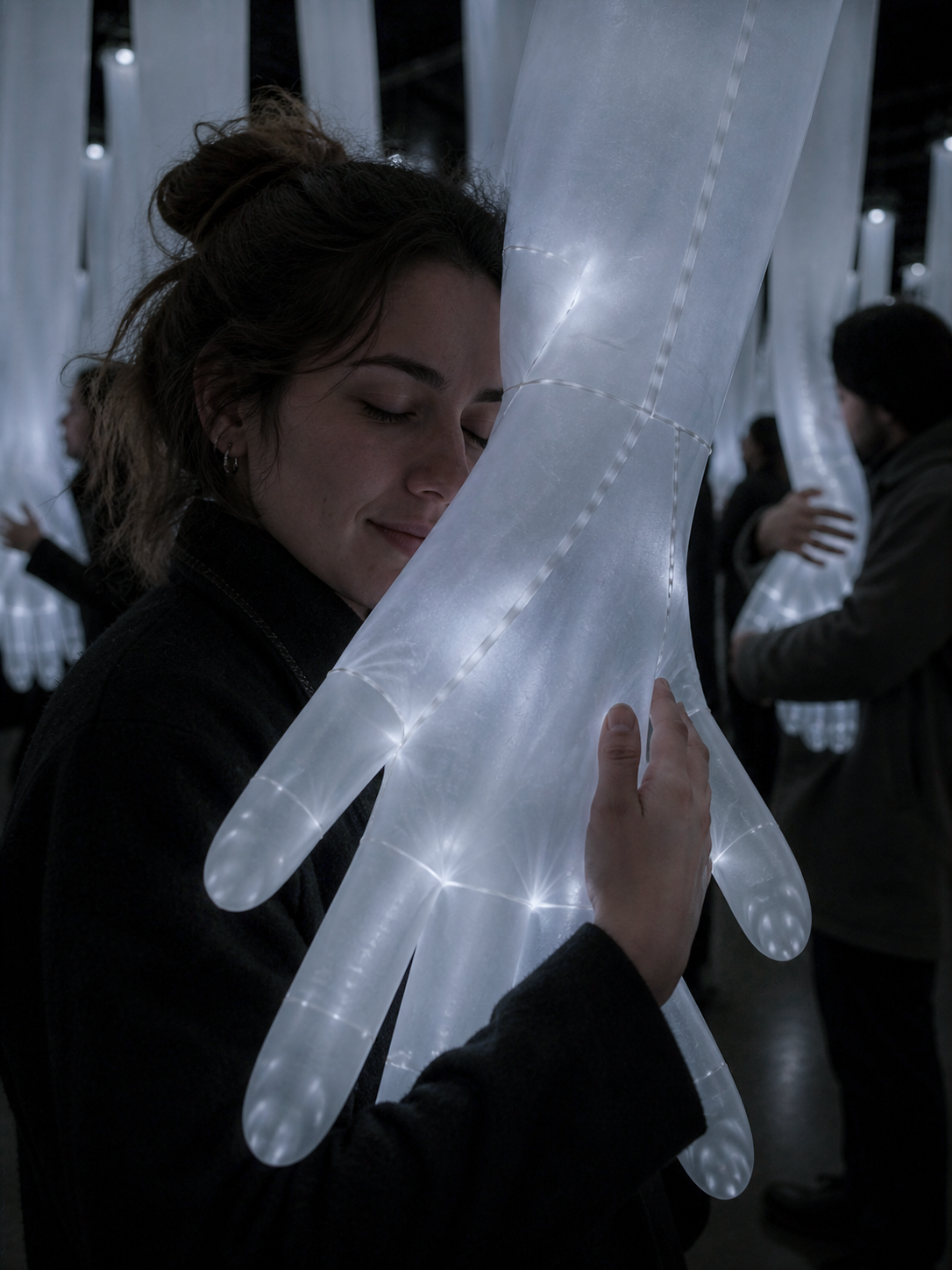

One of the most successful decisions in the work is the refusal to conceal the material’s imperfections. The internal illumination reveals seams, tension lines, folds, distortions, and the subtle irregularities produced by gravity. Many large-scale installations seek visual purity. Here, the light exposes construction. Every stitch becomes part of the visual language. The audience is allowed to see evidence of making, and that visibility strengthens the work’s credibility. The glowing arms feel present precisely because they remain vulnerable to scrutiny.
The choice of color temperature deserves careful attention. A warmer source would have introduced emotional familiarity too quickly. The installation would risk drifting toward sentimentality. The cold white light maintains a degree of distance between the visitor and the object. Touch occurs within an atmosphere that remains slightly detached, almost clinical. This tension becomes one of the project’s most interesting qualities. The work proposes intimacy while preserving ambiguity. The visitor receives contact from an object that appears alive enough to provoke a reaction, yet remains unmistakably artificial.
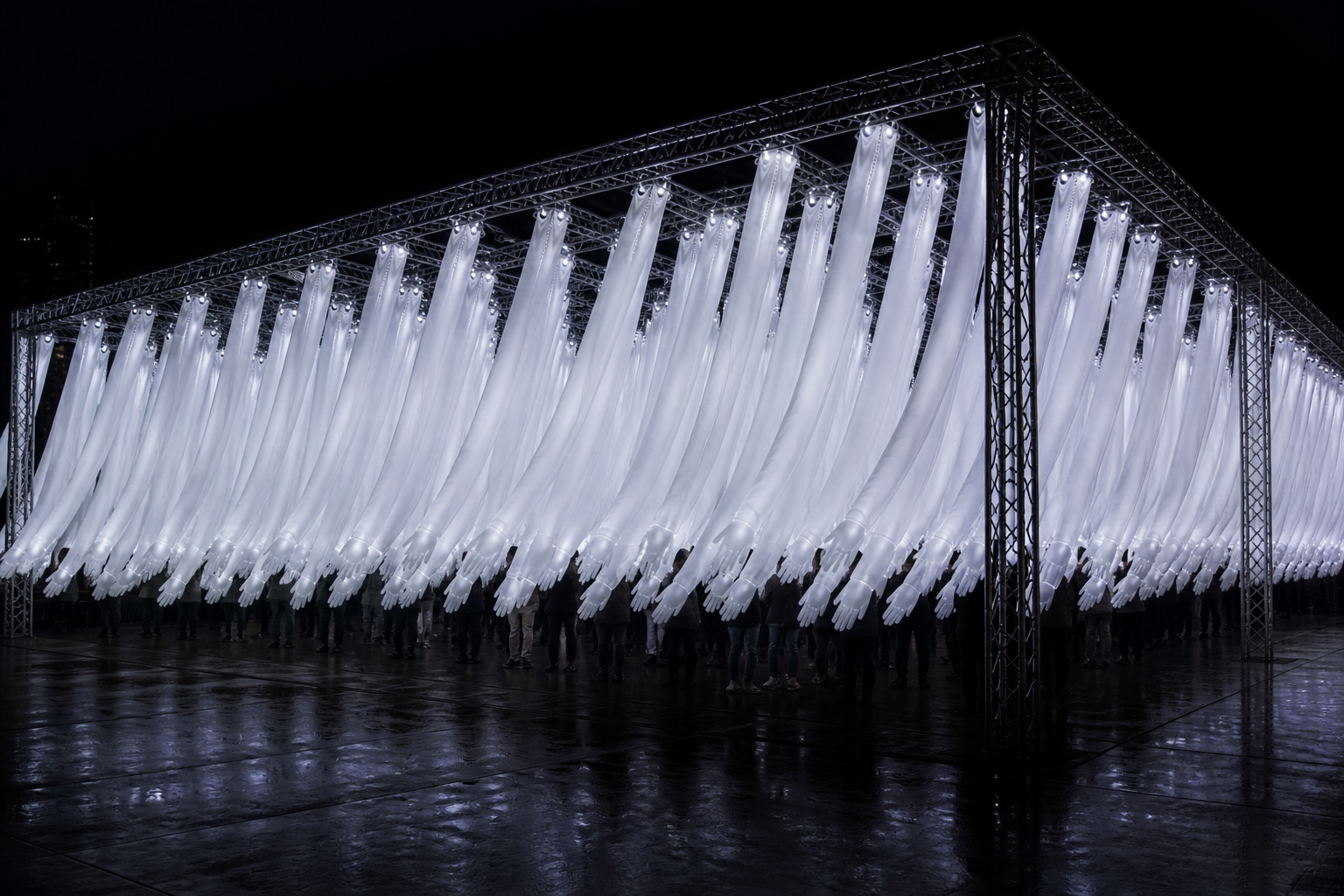
From a lighting perspective, the project demonstrates a sophisticated understanding of translucency. The fabric does not simply diffuse light. It stores it. Throughout the arms, luminosity appears suspended within the textile volume rather than projected outward. This creates an unusual perceptual condition. The arms seem less like illuminated objects and more like containers holding a soft internal glow. As visitors move through the field, brightness appears to shift continuously despite the light sources remaining fixed. The movement of the fabric alters thickness, overlap, and density, creating countless small variations in transmission. The environment therefore acquires a dynamic quality without relying on programming, sensors, or changing light levels.
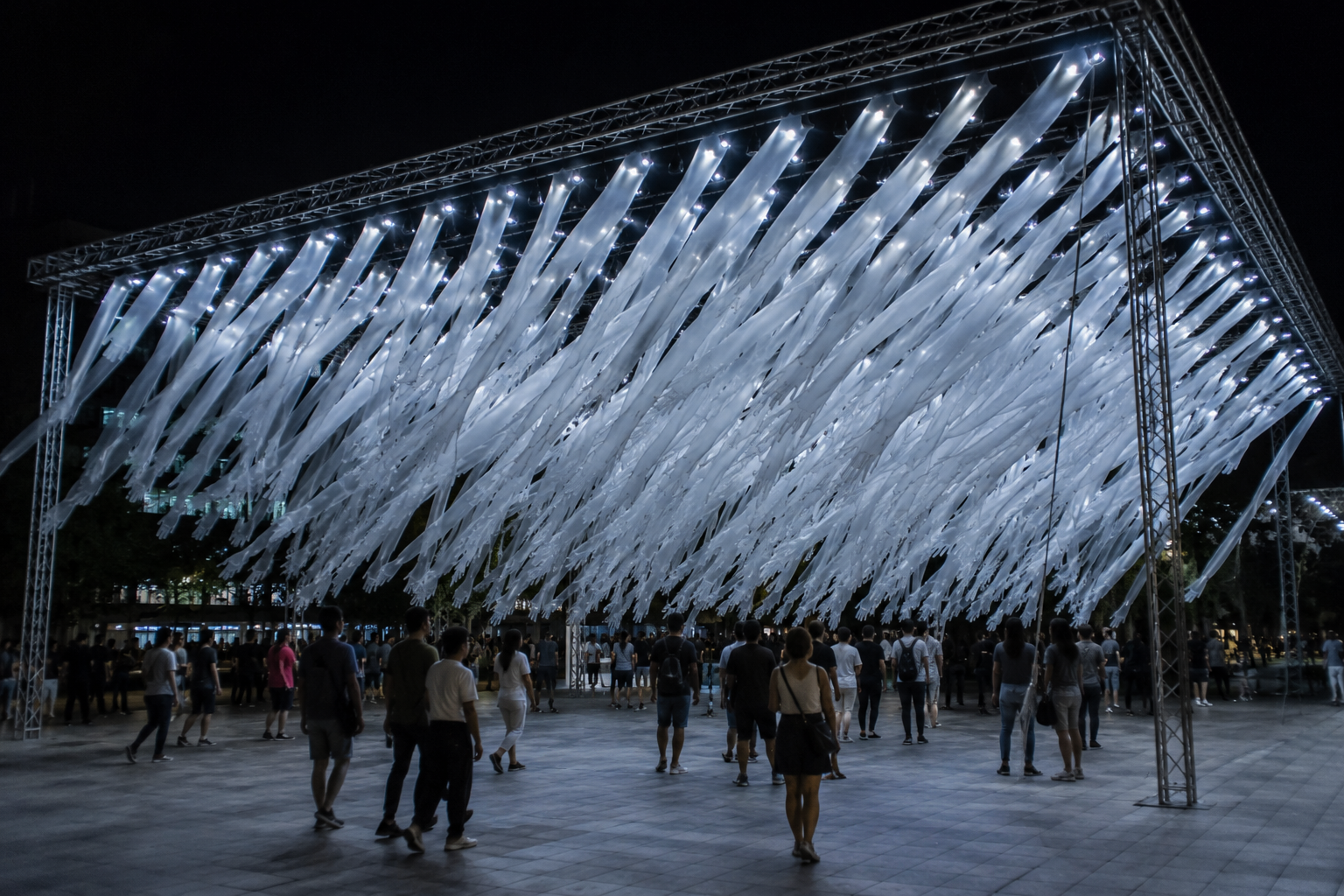
What makes this particularly effective is that the movement is authored by environmental forces rather than technological systems. Wind becomes an active lighting instrument. Air pressure reshapes the visible distribution of light moment by moment. The installation demonstrates how kinetic behavior can generate visual complexity without requiring complex lighting technology. There is an economy to this decision that deserves recognition. The project extracts considerable atmospheric richness from relatively simple means.
The relationship between illumination and scale is also handled with restraint. Large public installations frequently depend on increasing brightness as size increases. Here, luminosity remains controlled. The arms glow softly even when multiplied into the hundreds. This restraint prevents the installation from overwhelming the space. The field of light remains inhabitable. Visitors can occupy the work rather than merely observe it from a distance. The atmosphere encourages lingering. People slow their pace naturally because the visual information unfolds at the speed of movement.
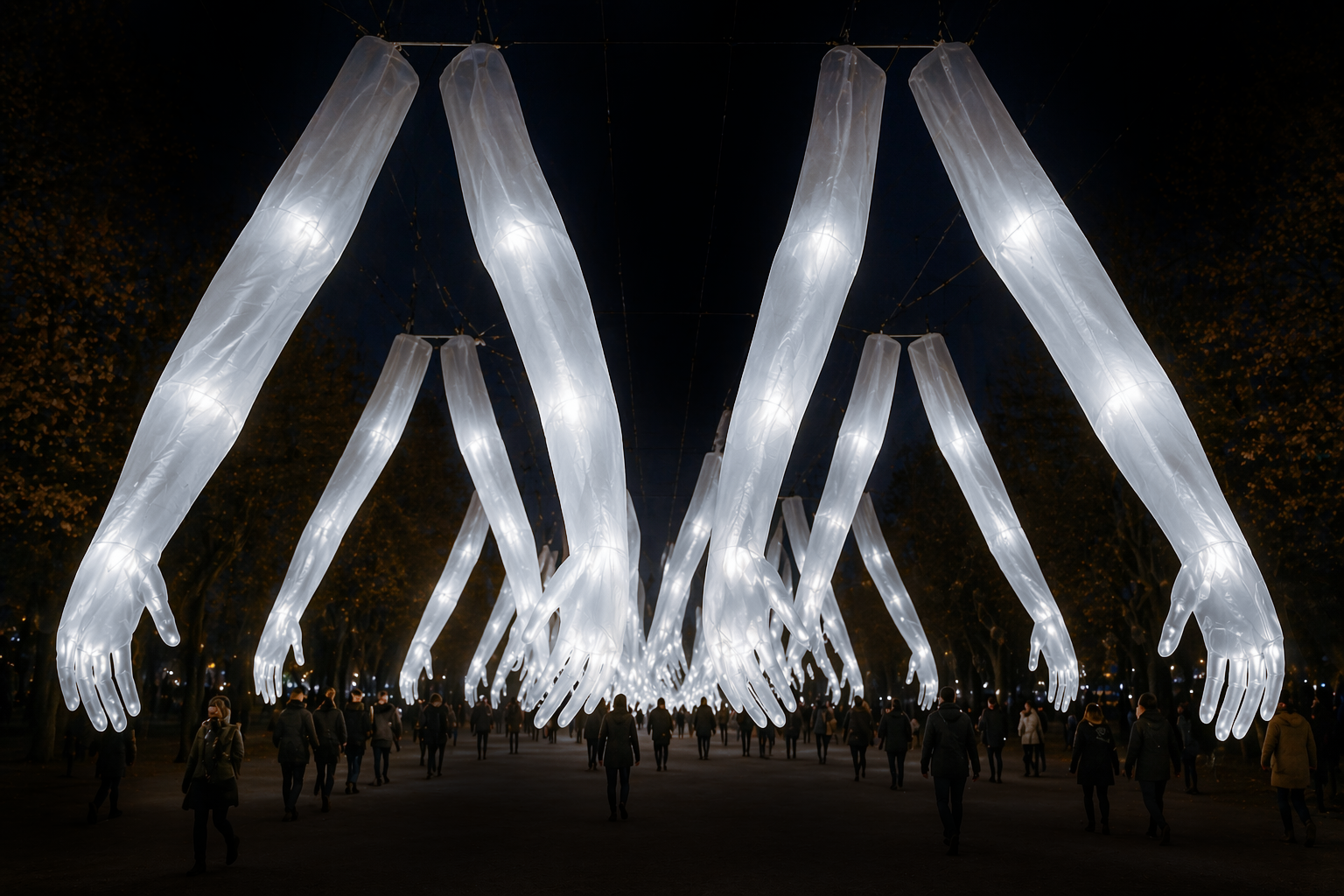
One of the most revealing aspects of the project is the way light redistributes attention. In most urban environments, illumination reinforces architecture. Buildings, monuments, pathways, facades, and infrastructure become the primary recipients of visual emphasis. Caressing Zone redirects focus away from the city itself and toward the volume between bodies. The illuminated arms occupy air. They transform empty space into the subject of observation. Visitors begin looking upward, sideways, and into the gaps between objects. The work constructs an environment where the normally invisible dimension of public space gains visual weight.
This shift carries significant implications for how the installation is experienced. The audience does not encounter light as a tool for orientation. Light becomes evidence of presence. Each glowing arm marks a small territory of contact suspended above the crowd. When viewed collectively, these territories merge into a luminous canopy whose boundaries remain uncertain. The eye struggles to identify where one gesture ends and another begins. The installation acquires a spatial softness that extends far beyond the physical dimensions of each object.
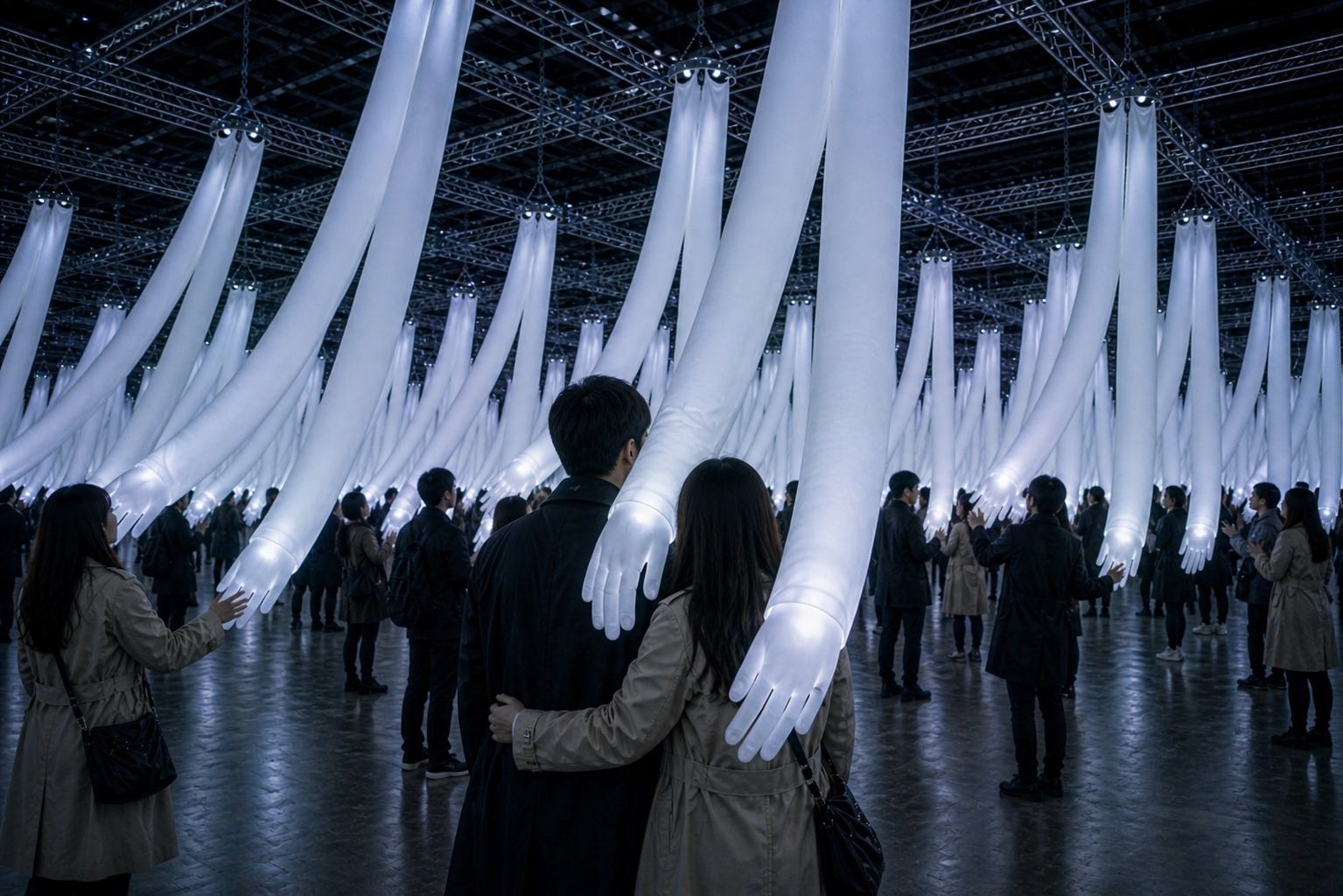
There is also an interesting relationship between repetition and individuality. Hundreds of arms are fabricated from the same system, illuminated by the same source, and suspended according to the same logic. Yet no two appear identical once movement enters the equation. Light amplifies these differences. Slight twists in the fabric alter shadow patterns. Minor variations in tension change the way illumination accumulates inside the textile volume. Visitors encounter a population of forms rather than a collection of duplicates. The installation gains visual depth through these subtle deviations.
The project’s strongest achievement may lie in its understanding of human perception at close range. Many immersive environments are designed to be photographed. Their primary success is measured through distant views and dramatic compositions. Caressing Zone performs differently. Its most convincing moments occur when the visitor occupies a distance of only a few inches from the illuminated fabric. At that scale, the light reveals texture, stitching, compression, and movement. The work rewards physical presence. Photography captures the atmosphere effectively, yet much of the installation’s intelligence emerges through proximity.
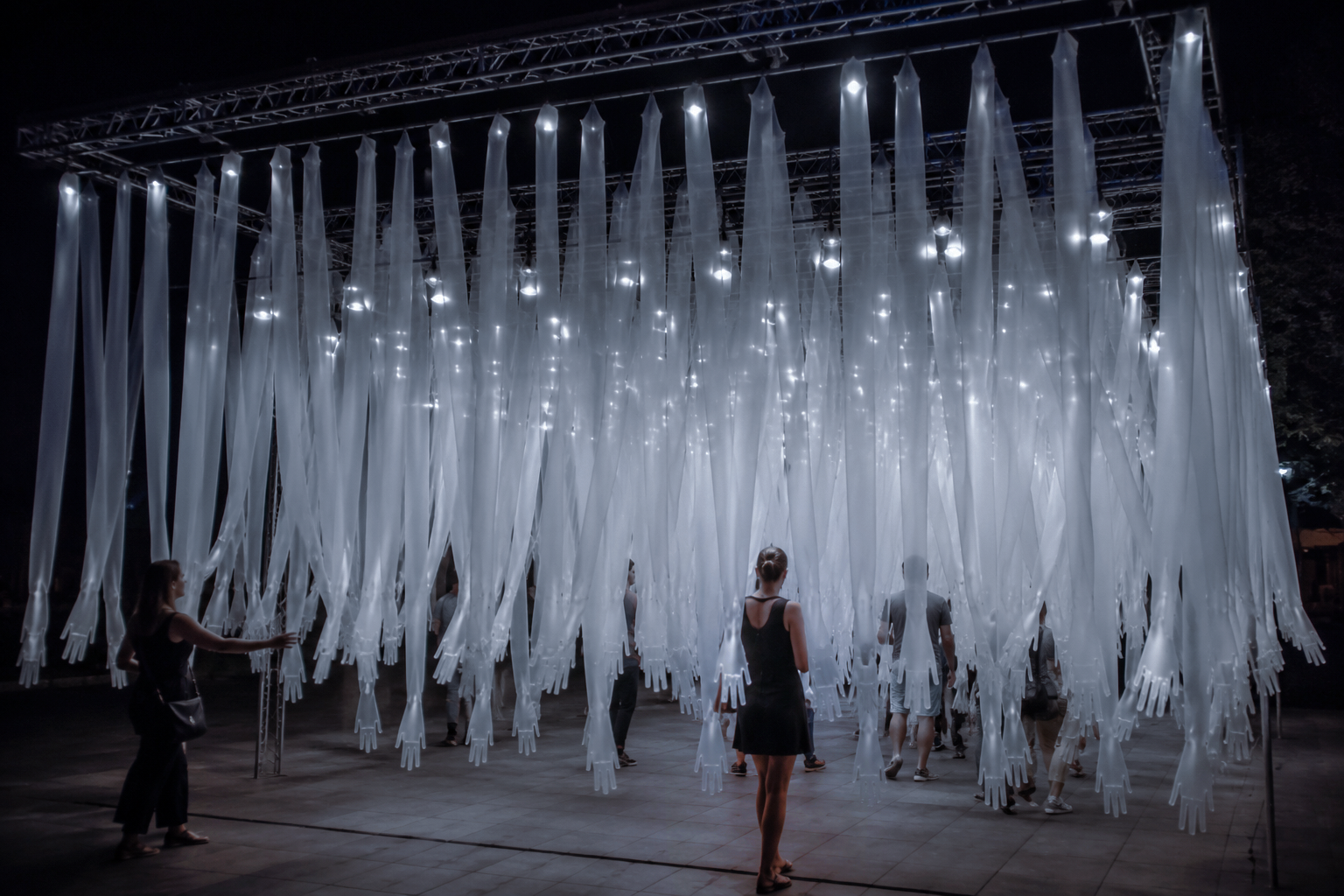
There are, however, areas where the project becomes vulnerable. The uniformity of the lighting system occasionally produces visual predictability. Because every arm operates according to the same luminous logic, certain zones risk becoming optically repetitive over extended periods of engagement. The installation depends heavily on environmental movement and audience interaction to maintain variation. In locations with limited airflow or lower visitor density, some of the visual vitality visible in the documentation could diminish.
Another challenge concerns the symbolic clarity of the arm itself. The form carries immediate cultural associations. Hands, touch, care, comfort, protection, and human presence become available interpretations almost instantly. This accessibility contributes to the work’s public appeal. At the same time, it narrows the field of possible readings. The audience receives the central gesture quickly. The installation’s deeper complexities emerge through material behavior, scale, and spatial occupation rather than through the symbolism of the object. The lighting design participates in this dynamic. It enriches the physical experience significantly, though it rarely complicates the meaning of the form.
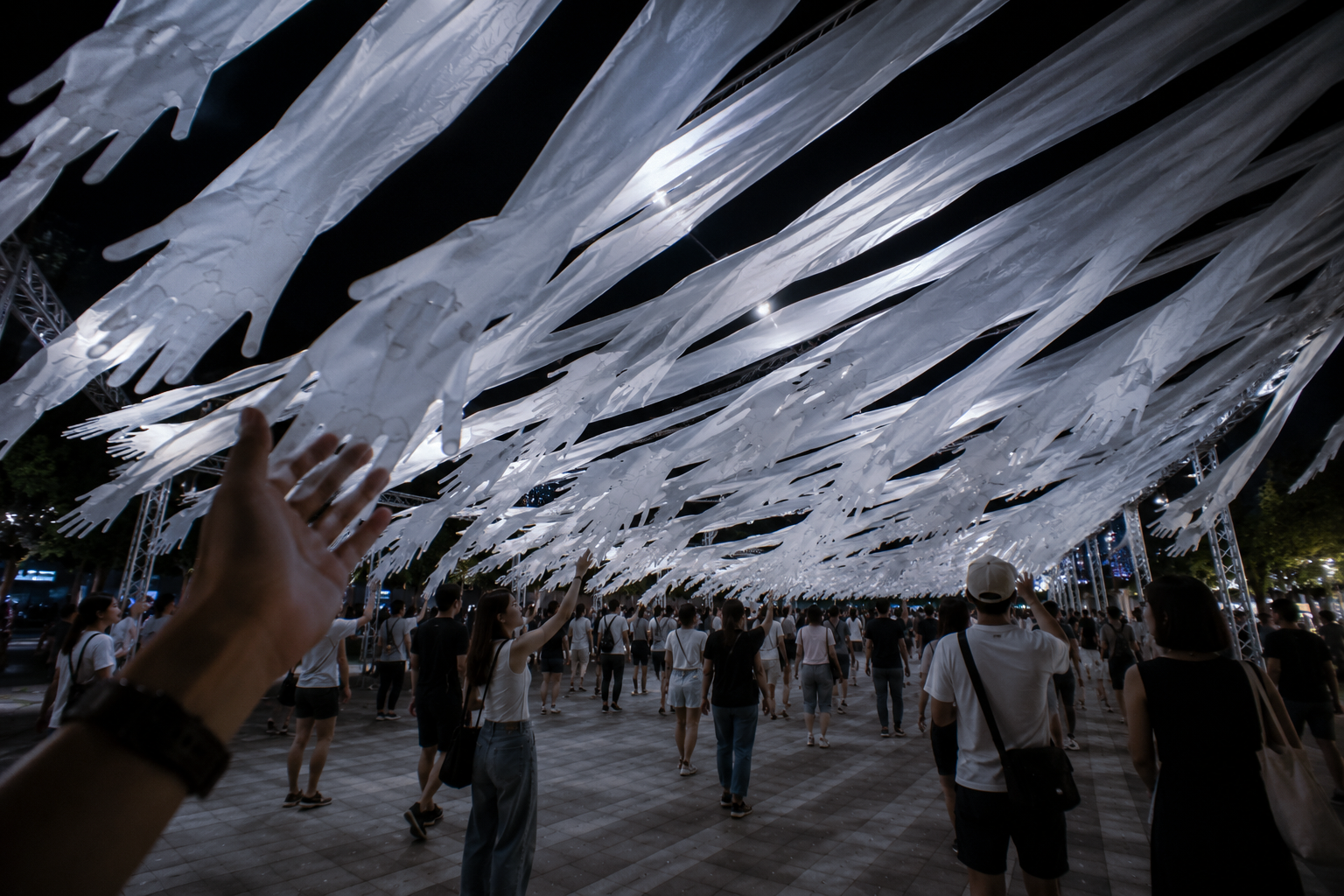
Yet this observation ultimately points toward the project’s priorities rather than a flaw. The designers appear less interested in conceptual opacity than in constructing a condition. Their attention remains focused on atmosphere, bodily awareness, and altered patterns of movement. Within that framework, the lighting performs with remarkable precision. It does not seek attention for itself. It creates the circumstances under which fabric, air, gravity, and human bodies become visible to one another.
What lingers after viewing the work is not the memory of individual luminaires or technical solutions. It is the memory of a public space behaving differently. The lighting gives the installation its pulse. It transforms inert textile sleeves into luminous presences, grants visibility to movement that would otherwise disappear into darkness, and establishes a visual rhythm capable of extending across an entire architectural field. The project understands that light can function as a medium of contact without becoming theatrical. It can remain quiet and still alter the social character of a space.
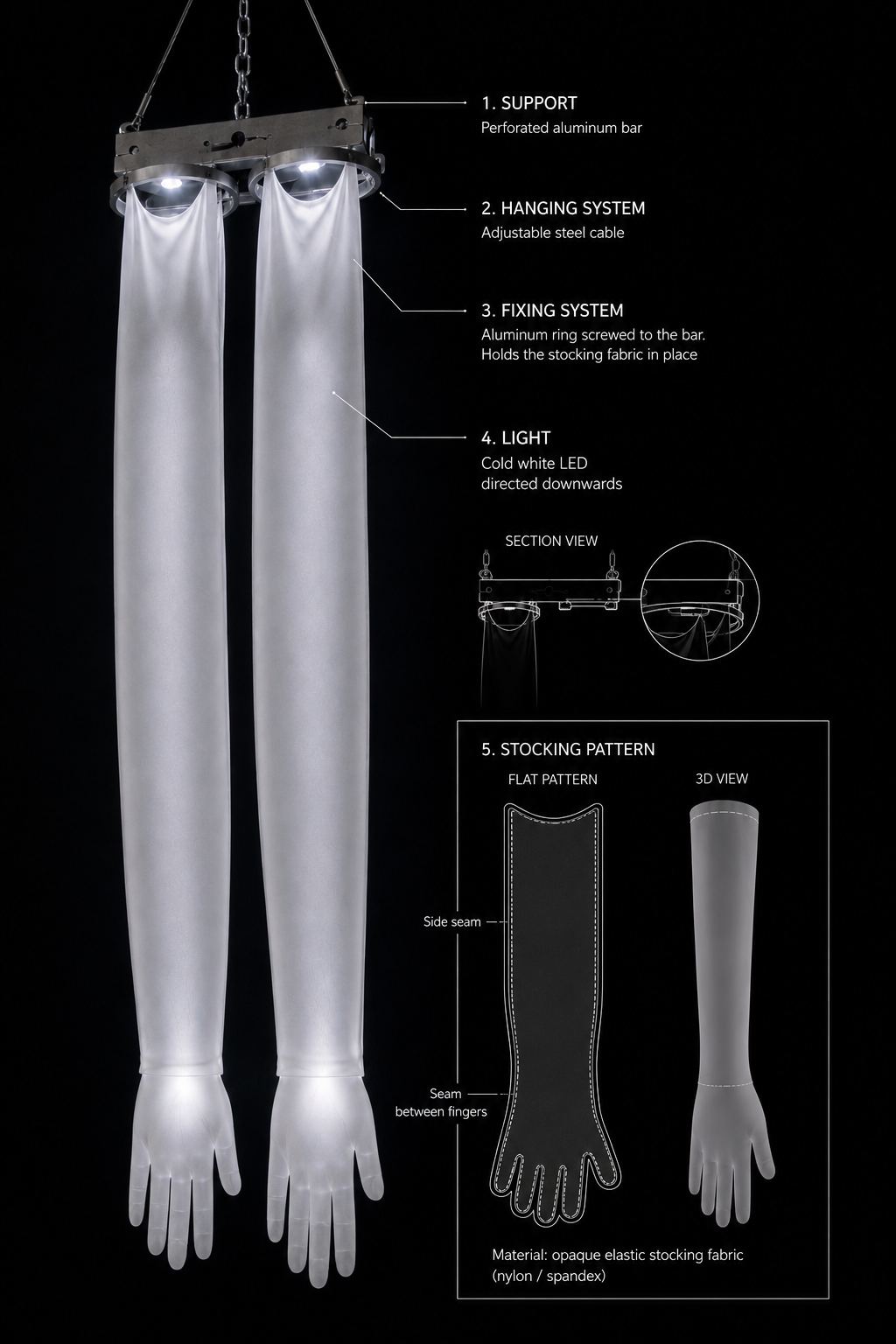
Seen from a distance, the installation resembles a drifting constellation suspended just above the city. Seen from within, it becomes a field of small encounters. The lighting bridges these two scales with unusual discipline. It provides enough illumination to sustain the illusion of bodily presence, enough restraint to preserve ambiguity, and enough material revelation to keep the work grounded in physical reality. That balance is difficult to achieve. Many installations collapse into spectacle or disappear into concept. Caressing Zone remains attentive to the fragile territory between object, atmosphere, and human perception, and its lighting design is the mechanism that allows that territory to exist at all.