









Introduction
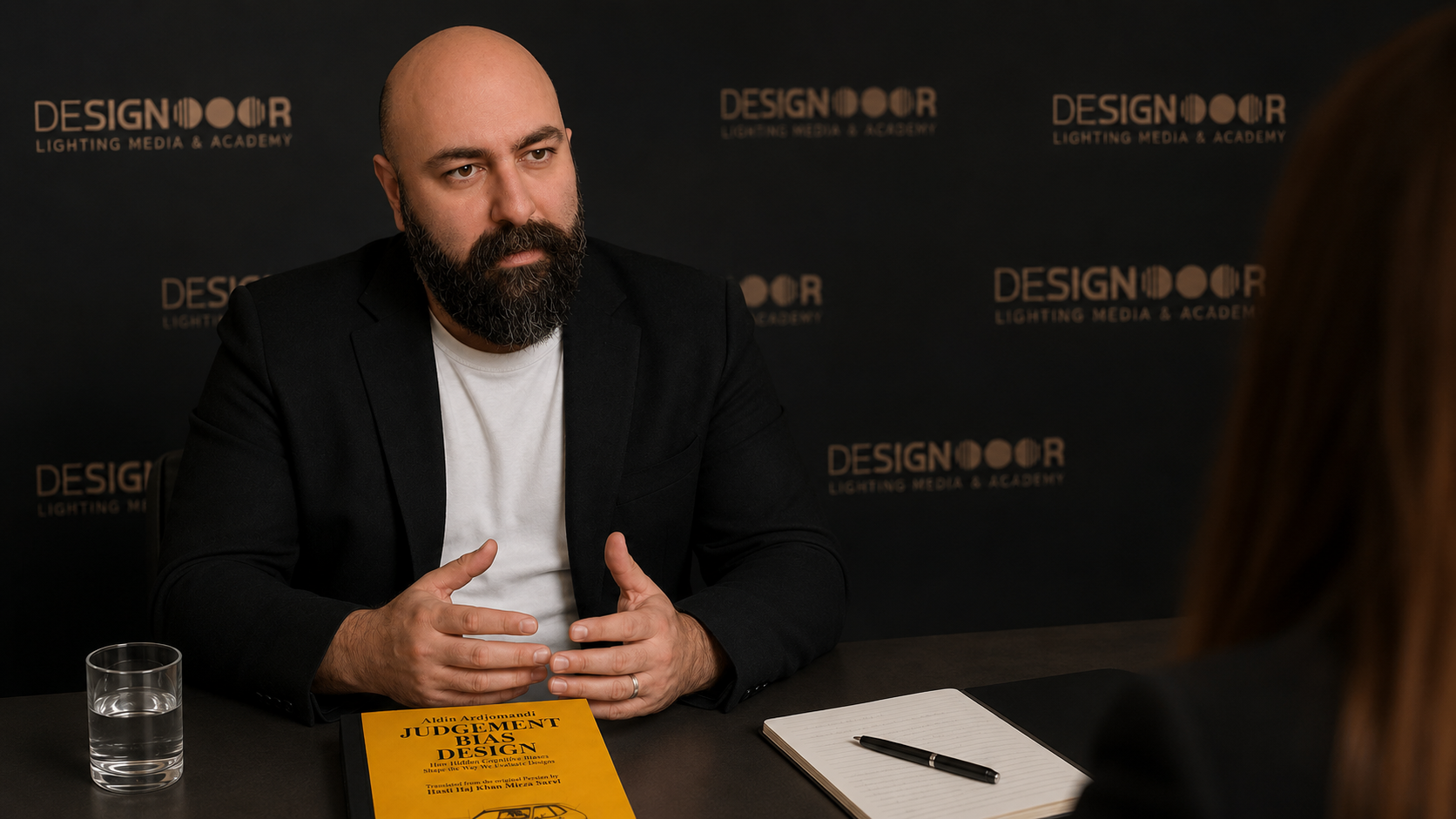
Designooor’s Editorial Manager discusses his new book, the hidden forces behind design evaluation, and what years of working as a designer, educator, editor, and international juror have taught him about the fragile act of deciding what deserves attention.
Designooor’s editorial work is rooted in lighting design, lighting products, and the broader ideas that shape how light is created, experienced, communicated, and evaluated. We regularly encounter projects in which technical performance, visual identity, atmosphere, materiality, innovation, and human experience must all be considered at the same time.
Yet before a lighting product, installation, or design project is praised, criticized, published, awarded, or rejected, another process has already begun: the act of judgment. 
What happens inside the mind of the person looking at a design? How much of an evaluation comes from the work itself, and how much is influenced by reputation, presentation, familiarity, professional background, cultural expectations, or the first emotional response?
These questions have followed Aidin Ardjomandi through several areas of his professional life. As a product and lighting designer, he has made decisions about form, function, material, illumination, and experience. As an educator, he has seen how critique can influence the confidence and direction of young designers. As an international juror, he has evaluated projects across different disciplines and cultural contexts. As Editorial Manager of Designooor, he works with another form of judgment: deciding what becomes visible, how a project is framed, and what kind of conversation may develop around it.
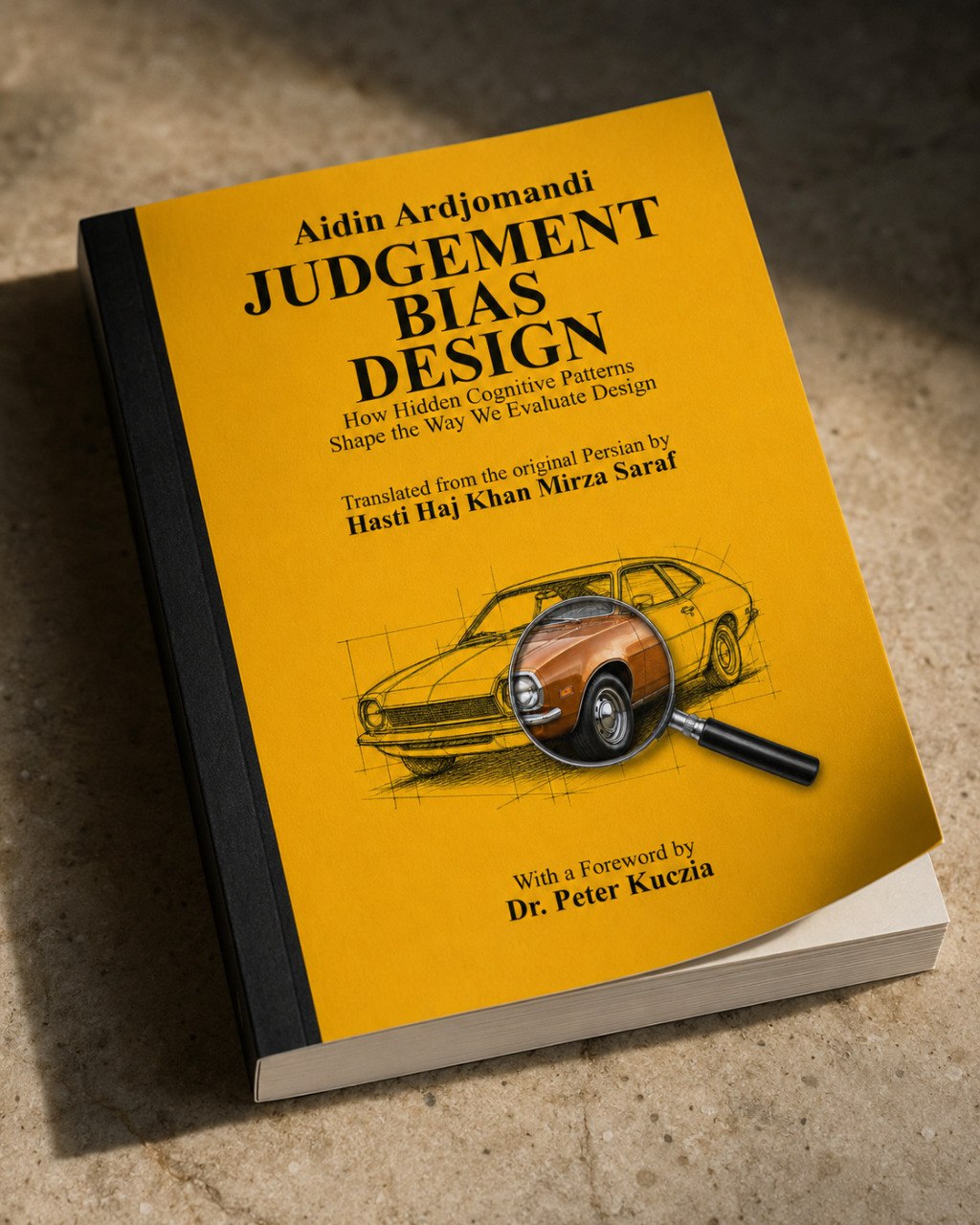
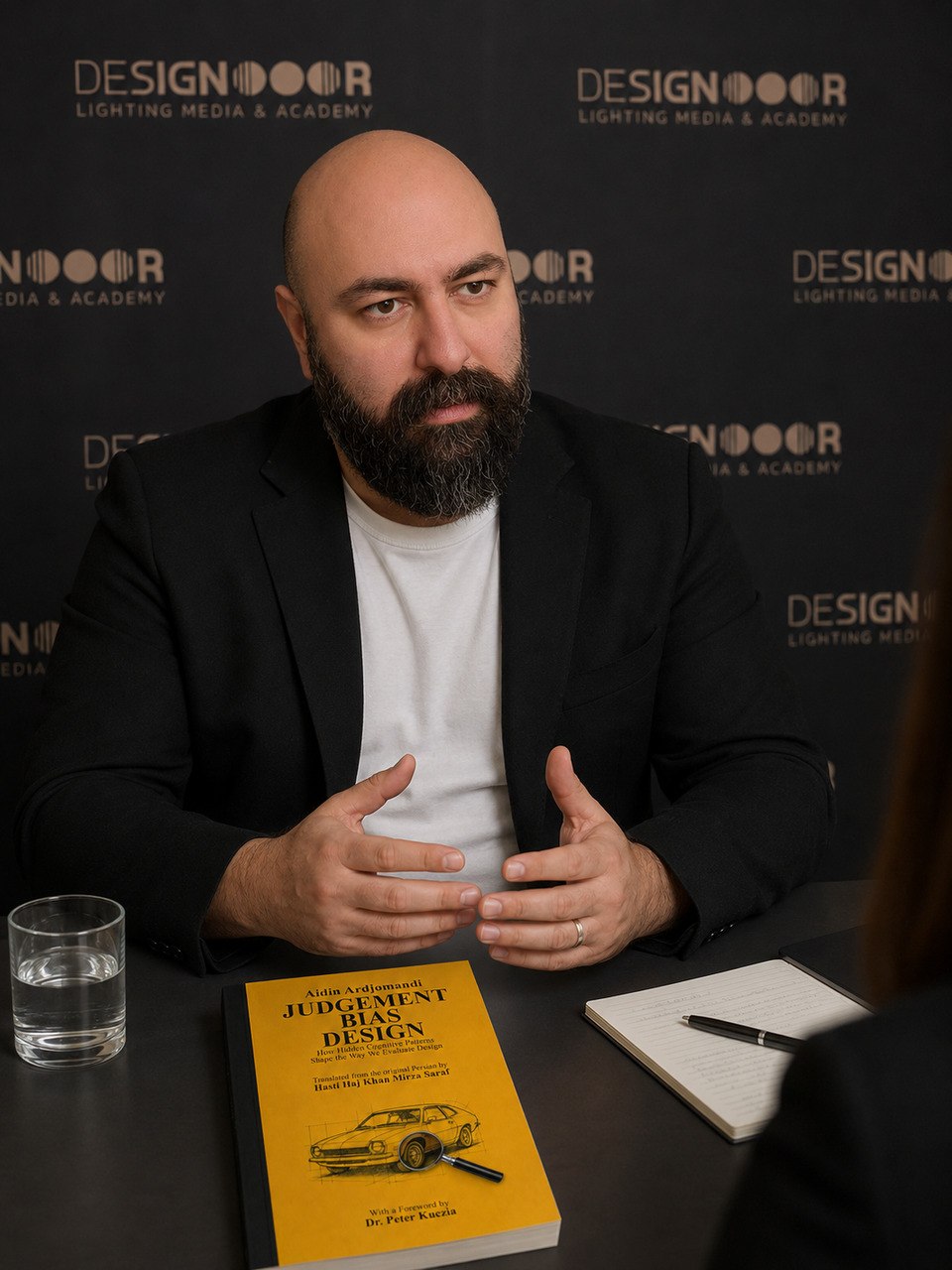
His new book, Judgement, Bias, Design: How Hidden Cognitive Patterns Shape the Way We Evaluate Design, brings these experiences together. Originally written in Persian and later published in English, the book includes a foreword by architect, curator, and juror Dr. Peter Kuczia. Across its chapters, Ardjomandi examines the halo effect, relative perception, confirmation bias, survivorship bias, and the more personal experience of living under judgment.
Judgement, Bias, Design is not intended as a handbook for achieving perfect objectivity. Ardjomandi does not believe such objectivity exists. Instead, the book asks whether designers, critics, editors, educators, clients, and jurors can become more conscious of the forces shaping their decisions.
For this special interview, the Designooor editorial team turns the questions inward.
Interview
Designooor: Before we discuss the book, how would you introduce yourself to someone encountering your work for the first time?
Aidin Ardjomandi: The most honest answer is that I have never managed to remain in one professional room for very long.
I began with industrial and product design, but my work gradually moved into lighting design, education, writing, criticism, editorial practice, and international jury work. For a while, I thought I had to choose one of those identities and present it as the central one. Eventually, I realized that the movement between them was probably the most important part of my work.
Designing teaches you how difficult it is to make a decision. Teaching shows you what happens when your decision affects another person’s confidence. Jury work gives that decision professional consequences. Editorial work determines what people will see, read, and perhaps remember.
They look like different jobs, but they all involve selection. You select a form, an argument, a project, a photograph, a title, a winner, or even the sentence you use when speaking to a student. The book grew out of that shared territory.
“The movement between my different roles is probably the most important part of my work.”
Designooor: Was there a particular moment when you realized that design judgment itself could become the subject of a book?
Aidin Ardjomandi: There wasn’t one dramatic moment. It was more like a discomfort that accumulated.
I had been serving on design juries for years, and I kept noticing situations that didn’t fit the clean image we often have of professional evaluation. A strong project could be weakened by a nervous presentation. A moderate project could become persuasive because the designer spoke confidently. A famous name could change the atmosphere around a piece of work before anyone had properly examined it.
Sometimes the first project in a sequence became the reference point for everything that followed. Sometimes one respected jury member expressed an opinion very early, and the room slowly moved in that direction. Nobody was necessarily acting dishonestly. That was what interested me. These were intelligent, experienced, well-intentioned people, and yet the decision could still be shaped by forces operating below conscious reasoning.
I began asking myself whether my own judgments were as independent as I believed they were. That was the uncomfortable part. It would have been much easier to write a book about the biases of other people.
Designooor: So is Judgement, Bias, Design partly a confession from a juror?
Aidin Ardjomandi: In a way, yes.
I don’t think someone can write honestly about cognitive bias while presenting themselves as the only unbiased person in the room. I have made quick judgments. I have been influenced by presentation, reputation, familiarity, context, fatigue, and probably many things I still haven’t recognized.
Experience helps, but experience can also create its own problems. The more experienced we become, the more easily we may confuse familiarity with truth. We say, “I know this kind of project,” when perhaps we have only seen something that resembles it. We believe our intuition has become reliable, and sometimes it has, but intuition can also become a very efficient carrier of old assumptions.
The book is not an attempt to discredit professional judgment. We need judgment. Design cannot develop without critique, comparison, selection, and decision. But I do think judgment becomes more responsible when the person making it accepts that expertise does not make the mind invulnerable.
“Expertise does not make the mind invulnerable. ”
Designooor: Why focus specifically on design? Cognitive bias affects almost every area of human life.
Aidin Ardjomandi: Because design occupies a particularly unstable space between the measurable and the interpretive.
We can measure the energy consumption of a lighting product, its lumen output, thermal performance, durability, manufacturing cost, or compliance with technical standards. Those things matter. But they do not tell us, on their own, whether the product is meaningful, elegant, appropriate, emotionally engaging, culturally intelligent, or genuinely innovative.
The moment we move into those questions, judgment becomes more complicated. Knowledge, intuition, culture, memory, professional background, and personal preference begin to overlap.
Two judges can agree completely about the technical performance of a luminaire and still disagree about whether its form is restrained or lifeless. One may see cultural richness where another sees visual excess. A familiar form may appear timeless to one person and unimaginative to another.
That does not mean every opinion is equally valuable or that design is simply a matter of taste. It means the criteria themselves require interpretation. The word “innovation,” for example, may mean new technology to one judge, a new social model to another, and a meaningful reinterpretation of tradition to someone else.
“Design occupies a particularly unstable space between the measurable and the interpretive.”
Designooor: One of the first subjects in the book is the halo effect. Why is it so important in design?
Aidin Ardjomandi: Because design is extremely vulnerable to first impressions.
A beautifully photographed product arrives with an advantage. So does a project associated with a famous designer, a respected studio, a prestigious university, or a successful brand. One strong quality begins to illuminate everything around it, even qualities that have not yet been properly examined.
The reverse happens too. A weak rendering, an unfamiliar name, or an awkward presentation can create a negative atmosphere around a genuinely thoughtful project.
The problem is not that presentation should be ignored. Communication is part of design. A designer has a responsibility to explain the work clearly. But there is a difference between evaluating communication and allowing communication to replace the evaluation of everything else.
A polished image can make us assume that the product is well resolved, manufacturable, comfortable, sustainable, and original. Sometimes it is. Sometimes we have simply allowed one impressive feature to answer questions that were never actually investigated.
“Design is extremely vulnerable to first impressions.”
Designooor: This seems particularly relevant now, when so much design is first encountered through renders and social media.
Aidin Ardjomandi: Absolutely. We are living through a period in which many designs are judged before they have been physically experienced, and sometimes before they have been physically produced.
The image may be more convincing than the product could ever be. Materials behave perfectly. Light falls exactly where it should. There are no fingerprints, awkward reflections, wiring problems, manufacturing tolerances, damaged surfaces, uncomfortable proportions, or confused users.
That does not make rendering dishonest. Rendering is a legitimate design and communication tool. The problem begins when visual persuasion is mistaken for evidence.
Social media also rewards immediate legibility. A project must often communicate its idea in one or two seconds. That encourages designers to create work with a strong visual hook, but not every valuable design reveals itself that quickly. Some products make sense through repeated use. Some lighting environments depend on adaptation, movement, shadow, time, and peripheral perception. Those qualities are difficult to compress into one image.
A design culture dominated by first impressions may gradually begin producing designs made primarily to survive first impressions.
“Visual persuasion is often mistaken for evidence.”
Designooor: How does this connect to lighting design and to the work Designooor publishes?
Aidin Ardjomandi: Light is perhaps one of the clearest examples of how perception and judgment become inseparable.
Light does not only allow us to see a product or a space. It changes what we believe we are seeing. It can make a material appear warmer, more valuable, softer, heavier, cleaner, or more theatrical. It directs attention. It creates hierarchy. It hides certain information and intensifies other information.
In that sense, light is already a form of framing.
When we evaluate a lighting product, we may become attached to its silhouette and forget to ask what kind of light it actually produces. Or the opposite may happen: a technically sophisticated luminaire may be dismissed because its physical form appears too quiet in photographs.
Architectural lighting is even more complicated. A dramatic nighttime image can create an immediate emotional response, but the real project must also be understood through movement, adaptation, glare, contrast, maintenance, energy use, neighboring buildings, human comfort, and the way the space changes over several hours.
At Designooor, we work precisely within this tension. We need compelling images because lighting design is highly visual, but we must also look beyond the image. The challenge is to understand whether the photograph reveals the lighting design or merely advertises it.
“Light is already a form of framing.”
Designooor: Does your position as Editorial Manager influence the argument of the book?
Aidin Ardjomandi: Very much.
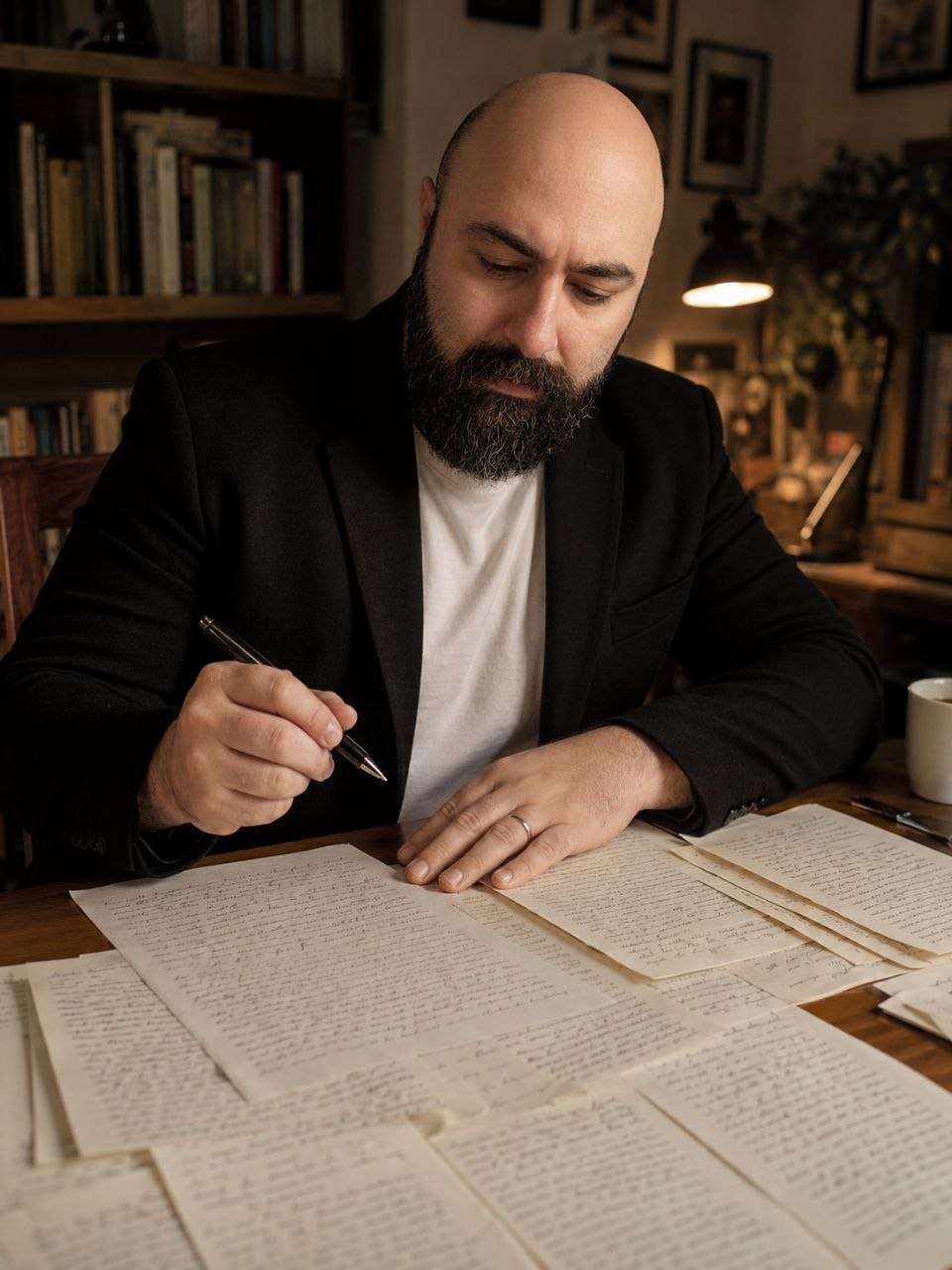
Editorial work is a form of judgment, although it often appears softer than jury work. A jury says yes or no in a visible way. An editorial team makes many quieter decisions. Which project will be published? Which image will represent it? Which part of the story appears in the title? What information is placed at the beginning, and what is left near the end where fewer people may reach it?
Those decisions shape interpretation before the reader has independently encountered the project.
Even the vocabulary matters. Calling something “revolutionary” creates a different reading from calling it “experimental.” Describing a product as “minimal” may give it cultural legitimacy, while calling it “basic” can reduce its perceived value, even if the physical product is identical.
Working at Designooor has made me more aware that publications do not simply report design culture. They participate in constructing it. What we repeatedly publish begins to look important. What we ignore may gradually disappear from the visible history of the field.
This is closely connected to survivorship bias, which I discuss in the book. We often study the projects that survived through awards, museums, publications, famous brands, and design history books. We rarely see the equally ambitious projects that failed, were rejected, could not be manufactured, came from less visible regions, or simply lacked access to the right platforms.
“Publications do not simply report design culture. They participate in constructing it.”
Designooor: Did writing the book make you more hesitant as an editor or juror?
Aidin Ardjomandi: For a while, yes. You can become almost paralyzed once you start noticing how many forces may be influencing a decision.
But permanent hesitation would not be useful. The purpose is not to stop judging. It is to create a small interruption between reaction and conclusion.
I often describe it as a pause. Not a dramatic philosophical pause. Sometimes it is only a few seconds in which you ask: What exactly am I responding to? Is it the work, the presentation, the designer’s reputation, the project I saw immediately before it, or my own preference for a familiar visual language?
That question does not always change the decision. It may confirm the first response. But even then, the reasoning becomes more visible.
A fair decision is not necessarily one made without subjectivity. That is probably impossible. A fairer decision is one in which subjectivity has been examined rather than disguised as absolute truth.
Designooor: Which bias do you consider most dangerous for designers themselves?
Aidin Ardjomandi: Confirmation bias, especially after success.
When designers are praised for a particular style, method, or visual language, they begin receiving evidence that this direction is correct. The evidence may be real. The work may deserve the recognition. But success can slowly turn a flexible approach into a fixed identity.
A designer known for minimalism may begin solving every problem through reduction, including problems that need richness, ornament, narrative, or cultural density. Another designer may become so attached to expressive complexity that restraint begins to feel like a betrayal of identity.
At that point, the designer is no longer responding to the project. The project is being used to confirm the designer’s previous beliefs about themselves.
We often say that a designer has found their voice, which sounds positive. But a voice can become a script. Style should help a designer think, not prevent them from thinking differently.
“Style should help a designer think, not prevent them from thinking differently.”
Designooor: The book also examines relative perception. How does comparison distort design evaluation?
Aidin Ardjomandi: We rarely judge a design in isolation, even when we believe we are doing so.
A product appears simple partly because we have just seen something complex. A lamp may seem inexpensive beside a more expensive model, even if we would have considered it costly on its own. A quiet project can feel intelligent after a sequence of visually aggressive ones. The same project might appear forgettable in another context.
Order matters. Context matters. The reference point matters.
This becomes important in competitions where judges review hundreds of entries. The first few projects can establish an unconscious standard. A spectacular project may make the following entries appear weaker than they are. Fatigue changes perception too. The fiftieth project is not being seen by exactly the same mind that evaluated the first.
Good evaluation systems try to reduce these effects through randomization, independent scoring, multiple rounds, clear criteria, and the opportunity to return to earlier entries. None of those methods creates perfect neutrality, but they can prevent a temporary comparison from becoming a permanent verdict.
Designooor: Survivorship bias is less frequently discussed in relation to design. What made you include it?
Aidin Ardjomandi: Because design history is full of visible winners and invisible absences.
We learn from successful products, famous studios, celebrated designers, iconic buildings, and award-winning lighting projects. Of course, those examples can be valuable. But if we study only what succeeded, we may misunderstand why it succeeded.
Perhaps the product survived because of excellent design. Perhaps it also benefited from distribution, capital, political stability, access to manufacturing, media attention, the reputation of the company, or simply fortunate timing.
Meanwhile, failed designs can teach us about manufacturing problems, market resistance, cultural mismatch, poor communication, technical limitations, or ideas that arrived too early. Yet failure is often removed from the official story because brands, designers, and institutions prefer a coherent narrative of success.
I would like to see more failure archives in design education. Not collections created to embarrass people, but serious records of what was attempted, what collapsed, and why. We lose an enormous amount of knowledge by preserving only the work that survived.
“Design history is full of visible winners and invisible absences.”
Designooor: The final main chapter, Living in the Shadow of Judgment, sounds more personal than the others.
Aidin Ardjomandi: It is.
The earlier chapters are concerned largely with the person who judges. That chapter turns toward the person being judged.
Designers do not experience evaluation as a purely intellectual process. A rejection can affect confidence. A careless critique can remain in a student’s mind for years. Constant exposure to public approval and disapproval can change the kind of work a designer is willing to attempt.
I have seen students begin designing for the instructor rather than for the problem. They learn the teacher’s preferences and slowly replace exploration with prediction. The same thing happens professionally. Designers may create for awards, algorithms, clients, or the visual habits of a particular publication.
This is another reason evaluation carries responsibility. A comment that feels ordinary to an experienced critic may become part of a young designer’s internal voice.
Criticism should be honest, but honesty is not the same as carelessness. The purpose of critique should be to help someone see the work more clearly, not to demonstrate the authority of the critic.
Designooor: The book was originally written in Persian. What changed when it moved into English?
Aidin Ardjomandi: More than I expected.
Translation is not the movement of information from one container to another. Language carries rhythm, emotional distance, humor, hesitation, and cultural assumptions. A sentence that feels natural and reflective in Persian may sound overly formal in English. Another sentence may become too direct.
The English edition also changed the potential audience. The book began in a specific professional and cultural context, but the questions are not limited to that context. Designers everywhere are judged. Students everywhere learn how authority sounds. Jury members everywhere bring memory, culture, fatigue, preference, and professional history into the room.
The language changed, but the vulnerability of judgment remained recognizable.
Designooor: Dr. Peter Kuczia wrote the foreword. Why was his perspective important to you?
Aidin Ardjomandi: Peter’s work has long been connected to the idea that design can educate, communicate, and carry responsibility. That made his perspective especially meaningful.
He is an architect and designer, but he is also a curator, educator, author, and experienced juror. He understands design from several positions, not only from the position of the person who creates it.
What I appreciated most about his foreword was that he did not present the book as a formula for flawless judgment. He understood that the subject is the human mind at work, with all its intelligence and all its limitations.
There is also a moment in the foreword where he acknowledges that his own positive response to the book is inevitably shaped by his biases. I found that both generous and appropriate. The foreword does not stand outside the argument. It enters it.
Designooor: Who did you imagine as the reader while writing Judgement, Bias, Design?
Aidin Ardjomandi: At first, I imagined jurors, because jury work was one of the main origins of the book. But the audience expanded very quickly.
Educators are making judgments every week. Editors and curators decide what becomes visible. Creative directors evaluate ideas before they exist as finished work. Clients judge proposals. Students judge themselves, often very harshly. Designers make hundreds of internal judgments while developing a project.
Even people outside the profession evaluate design constantly. They select products, respond to brands, enter spaces, trust or distrust interfaces, and form opinions about products without necessarily knowing how those opinions were formed.
So the book is for anyone interested in the distance between seeing something and believing that we understand it.
“The book is for anyone interested in the distance between seeing something and believing that we understand it.”
Designooor: After reading the book, what should a juror, editor, or designer do differently the following morning?
Aidin Ardjomandi: I would not ask them to distrust every reaction. That would be exhausting and probably impossible.
I would ask them to become curious about one reaction.
Choose the project you immediately loved or immediately disliked, and stay with it slightly longer. Separate the parts. Look at concept, function, execution, context, communication, and user experience independently. Ask whether one strong feature is dominating everything else.
Then ask one uncomfortable question: What evidence might change my mind?
That question is useful because we usually search for evidence that supports our first impression. Looking for evidence against it creates a small opening. You may still arrive at the same conclusion, but you will have arrived there with greater care.
Designooor: Is there one sentence that captures what you hope the book contributes to design culture?
Aidin Ardjomandi: Perhaps this: good judgment does not begin with certainty. It begins with attention.
I do not expect the book to eliminate bias. Bias is part of how the human mind manages complexity. But I hope it makes readers slightly less confident in the speed of their first conclusion and slightly more interested in what that conclusion may have missed.
Sometimes a fairer judgment begins with nothing more impressive than looking again.
“Good judgment does not begin with certainty. It begins with attention.”
About the Book
Judgement, Bias, Design: How Hidden Cognitive Patterns Shape the Way We Evaluate Design examines how cognitive biases influence the evaluation, criticism, teaching, publication, and creation of design.
Drawing on Aidin Ardjomandi’s experience as a multidisciplinary designer, educator, Editorial Manager of Designooor, and juror for more than seventy international design competitions and awards, the book explores how reputation, presentation, comparison, familiarity, culture, memory, professional hierarchy, and previous success can shape design judgment.
The book discusses the halo effect, relative perception, confirmation bias, survivorship bias, and the psychological experience of being judged. Rather than promising complete objectivity, it argues for reflective judgment, cognitive humility, structured evaluation, and a deliberate pause before conclusion.