







When a Half Ring Becomes a Portal
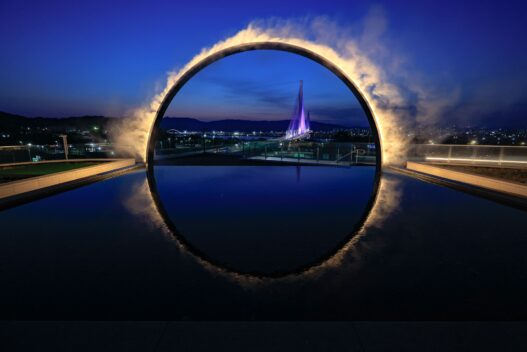
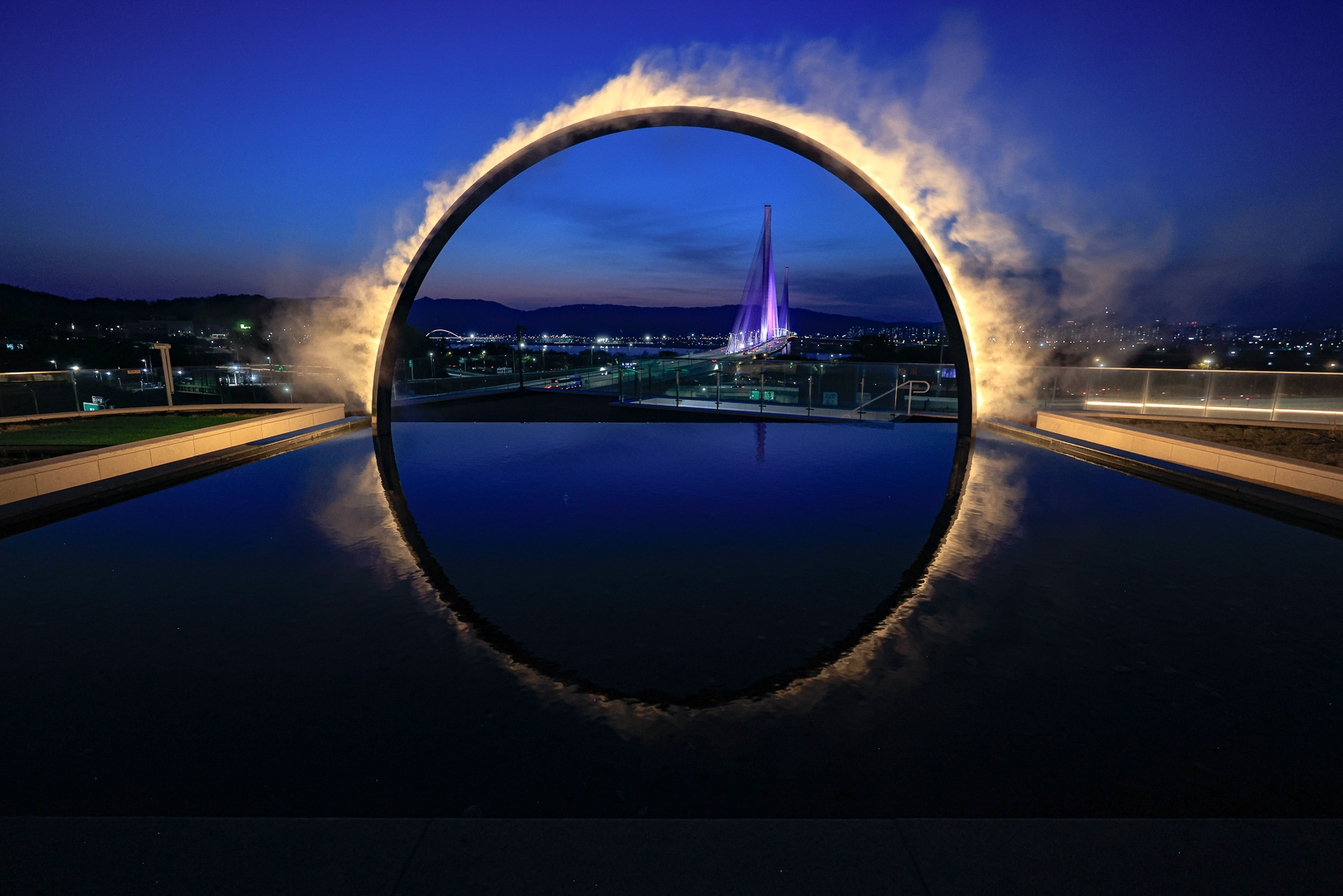
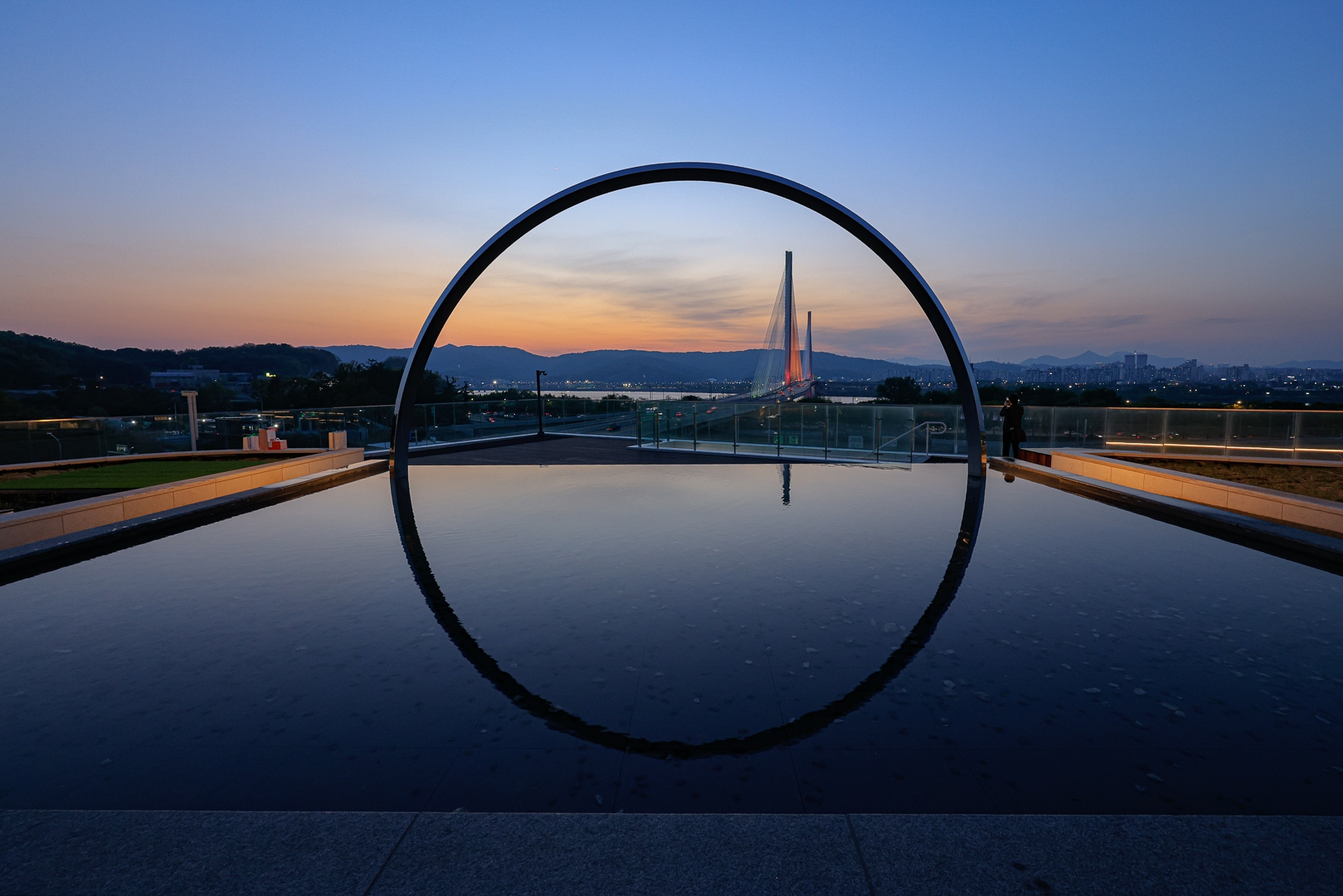
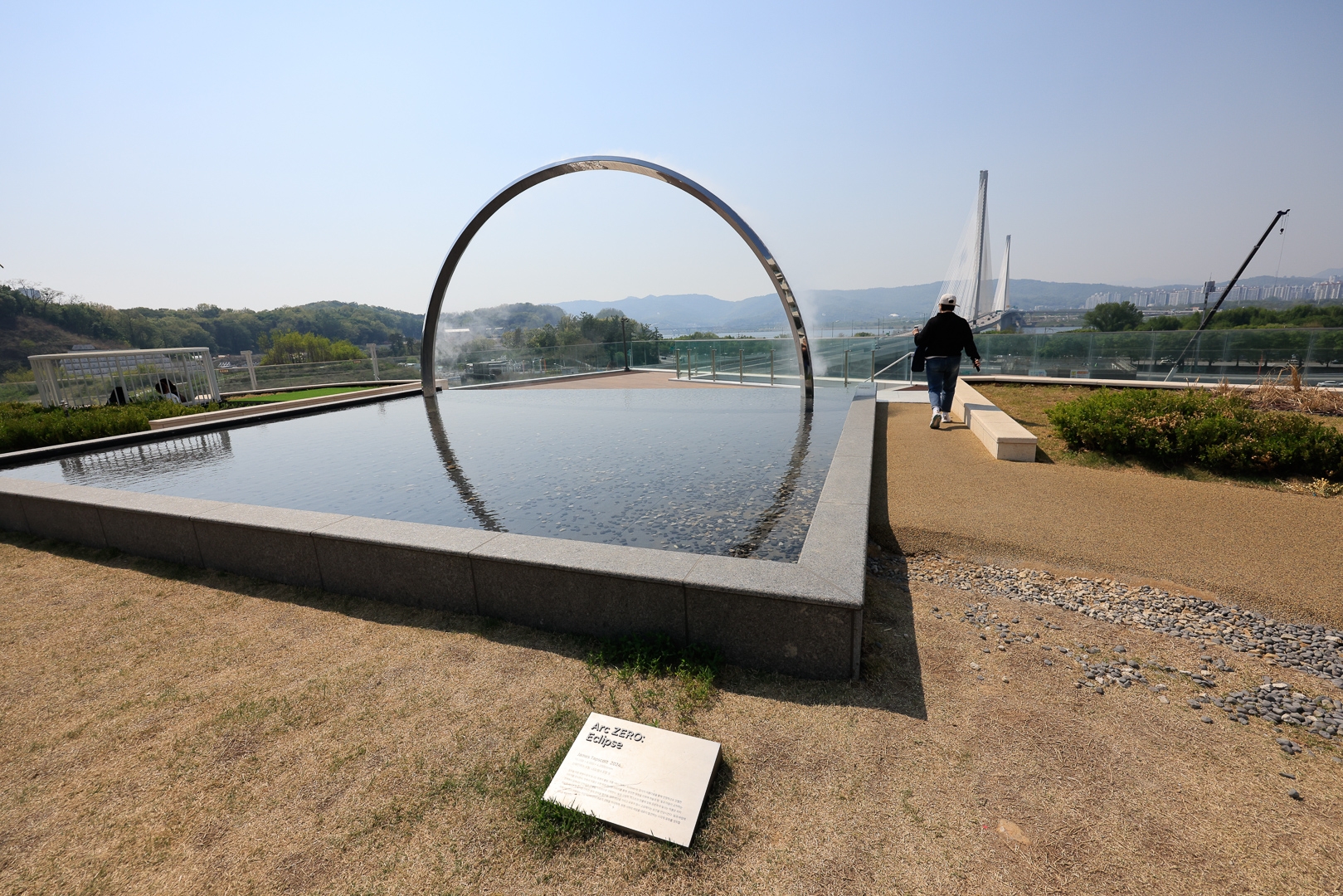
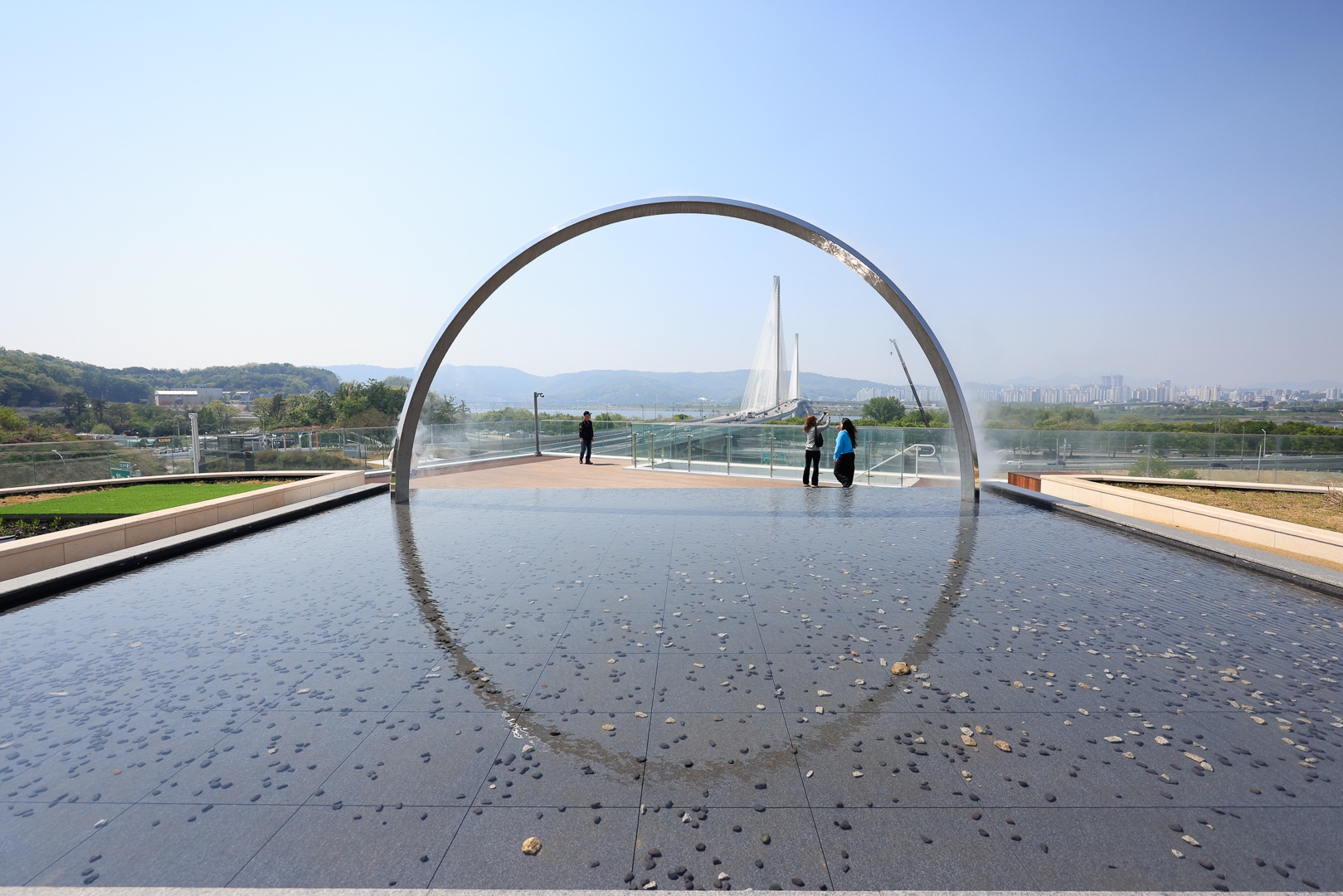
James Tapscott’s “Arc ZERO: Eclipse” is a rare lighting project in which illumination is not an accessory, a decorative finish, or a technical demonstration, but the condition through which the work becomes complete. In daylight, the installation appears almost austere. A polished stainless steel half ring that measures eight meters rises from a custom reflecting pool, its lower half completed by the water. The gesture is minimal, exact, and immediately legible. Yet this first impression is only a prelude. When night arrives and light begins to gather within the mist, the object changes category. It is no longer simply a sculptural form placed within a rooftop garden. It becomes an atmospheric event, a threshold, a framed disturbance in the ordinary fabric of the city.
This transformation is the central achievement of the project. Without light, the work remains elegant, but also relatively quiet. Its geometry is intelligent, and the reflection in the water gives it a pleasing formal resolution, yet the piece has not fully awakened. The unlit ring is a disciplined object. The lit ring is a passage. The difference is not superficial. It reveals that the true material of the project is not only steel, water, or mist, but perception itself. The lighting does not merely make the installation visible after sunset. It changes what the installation is.
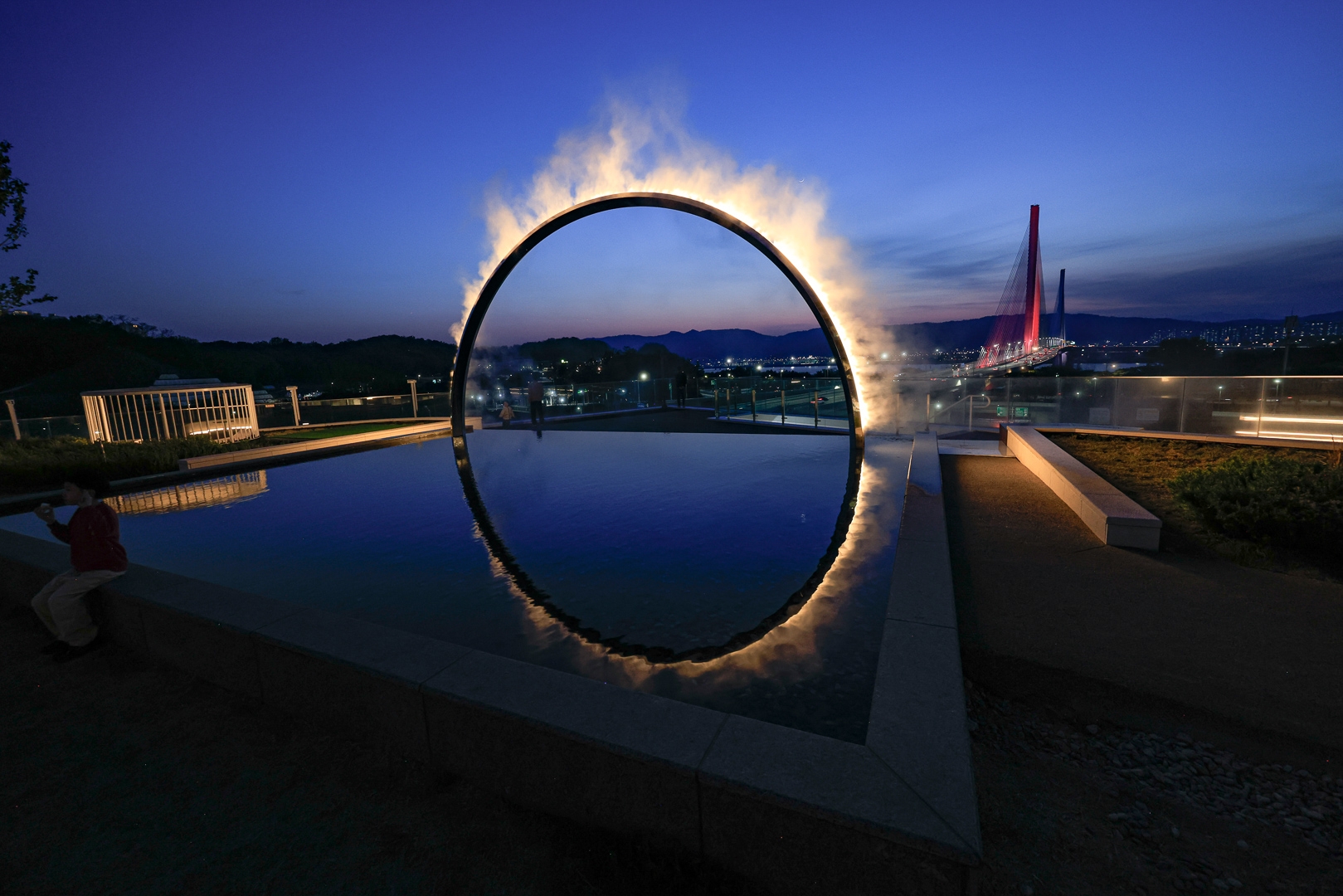

The title is carefully chosen. “Arc ZERO: Eclipse” does not reproduce an eclipse in any literal astronomical sense, but it does stage a comparable alteration of perception. During an eclipse, a familiar celestial body becomes strange. Daylight loses its authority. The known world is briefly reorganized by alignment, shadow, and wonder. Tapscott’s work performs a similar operation at architectural scale. A rooftop garden in Seoul becomes, for a moment, a place where infrastructure, atmosphere, reflection, and myth meet. The viewer does not simply look at a ring. The viewer looks through it, into a world that appears subtly changed by the act of framing.
This act of framing is one of the strongest aspects of the work. The iconic bridge beyond the installation is not treated as background scenery. It becomes part of the composition. Seen through the circular aperture, the bridge is transformed from infrastructure into image, from urban fact into symbolic presence. The city is not excluded from the artwork. It is gathered into it. This is where Tapscott’s sensitivity to site becomes evident. The work does not impose itself on Seoul through scale or spectacle alone. It listens to its surroundings and allows the surrounding landscape to complete its meaning.
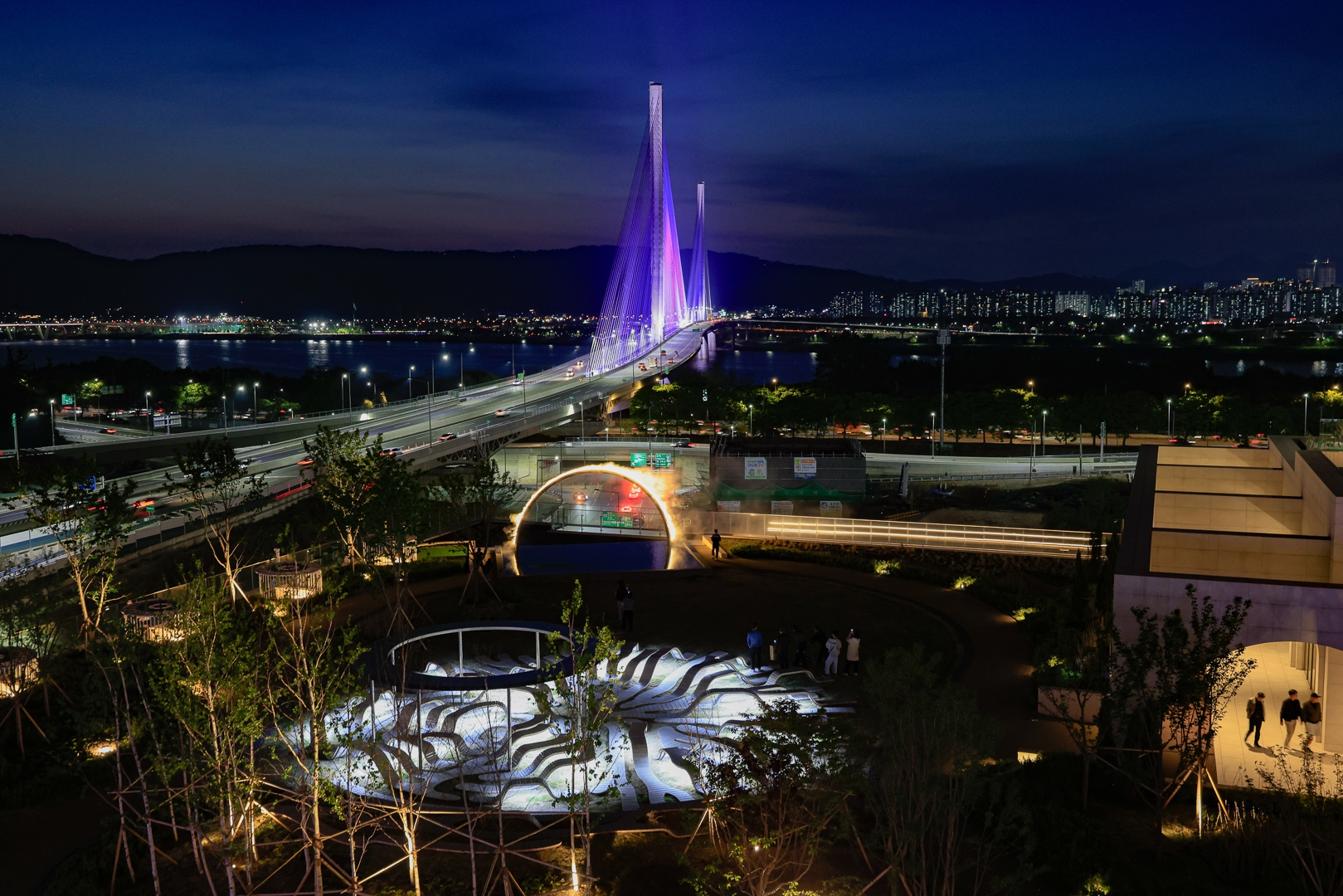
The project carries a quiet cultural resonance. The circular opening recalls the moon gate of East Asian Garden traditions, where geometry frames landscape and turns the act of seeing into a contemplative experience. It also evokes, without directly quoting, the symbolic function of sacred thresholds, from temple gates to ritual passages. Yet the installation avoids becoming a pastiche of cultural references. It does not borrow symbolism as ornament. Instead, it activates an older human intuition: that a circle, especially one completed by reflection and lit by vapor, can suggest entry into another order of reality.
The reflecting pool is essential to this reading. It is not a passive surface or a decorative base. It is the collaborator that completes the form. The half ring depends on water to become whole, and this dependence gives the work much of its poetic power. A full steel circle would have been more assertive, perhaps more iconic in a conventional sense, but it would also have been less vulnerable and less interesting. By refusing to complete the circle physically, Tapscott allows completion to occur through relationship. Steel meets water. Object meets reflection. Light meets mist. City meets horizon. The work becomes whole only through conditions.
This conditional quality places “Arc ZERO: Eclipse” within a lineage of art that treats perception as unstable and constructed. One might think of James Turrell’s skyspaces, where light and aperture make the sky appear newly manufactured, or Olafur Eliasson’s atmospheric installations, where fog, reflection, and artificial light transform environmental phenomena into collective sensory experience. Yet Tapscott’s project retains its own distinct character because it remains exposed to weather and urban circumstance. It is not sealed inside the controlled neutrality of a museum. Wind can shift the mist. Humidity can thicken or thin the luminous cloud. Water can tremble. The skyline can brighten or disappear into dusk. The work is never exactly the same twice, and this instability is not a weakness. It is part of its intelligence.
The illuminated mist is perhaps the most memorable element. It gives light a body. In conventional architectural lighting, light often behaves as emphasis, used to outline, highlight, or dramatize a structure. Here, light is made atmospheric. It appears to occupy the air, to breathe around the ring, to flare and dissolve at the edge of visibility. In the strongest views, the mist forms a glowing corona around the arc, recalling solar fire, lunar halos, ritual smoke, and the pale radiance of supernatural apparitions. The ring seems to burn without flame. It appears both solid and immaterial, engineered and elemental.
That tension between engineering and apparition is beautifully handled. The stainless steel ring is precise, controlled, and contemporary. The mist is unstable, ancient, and almost animistic. The meeting of the two prevents the work from becoming merely technological or merely romantic. Technology is present, but it is not the subject. It serves atmosphere. This is a crucial distinction. Many public lighting projects mistake brightness for significance. Tapscott’s work understands that the most powerful light is not always the most intense light. It is the light that changes the emotional temperature of space.
The comparison to cinema is difficult to avoid, though it should be made carefully. The ring has something of the mysterious authority of the monolith in Stanley Kubrick’s 2001: A Space Odyssey, not because it resembles it formally, but because it reorganizes the environment around a simple abstract presence. It also recalls the portal motif in science fiction and fantasy, those moments when a circular boundary opens onto another realm. Yet “Arc ZERO: Eclipse” is more restrained than cinematic spectacle. It does not require narrative. Its drama comes from stillness. Nothing needs to pass through the ring for the work to feel like a passage. The possibility is enough.
The literary imagination also finds a place here. The reflecting pool suggests the logic of the looking glass, a surface that doubles the world while quietly undermining its stability. Lewis Carroll’s mirror world may come to mind, though Tapscott’s atmosphere is far more solemn. There are deeper mythic echoes as well: thresholds to the underworld, prophetic pools, sacred fires, celestial rings, and the ancient belief that certain places briefly open onto forces larger than human design. The installation does not illustrate these references. It permits them to surface. That restraint is one of its virtues.
As a work within a mixed-use development, “Arc ZERO: Eclipse” also succeeds in giving the site more than a visual attraction. Rooftop gardens in contemporary developments often risk becoming amenities with a pleasant view and little inner life. This installation gives the rooftop a center of gravity. It turns an elevated garden into a place of encounter. From a distance, especially from passing cars on the nearby freeway, the glowing ring can register as a fleeting urban apparition. Up close, it offers a slower experience, one shaped by reflection, atmospheric drift, and the gradual adjustment of the eye. This dual function is not easy to achieve. A landmark seeks visibility. A sanctuary seeks inwardness. Tapscott manages to hold both conditions in balance.
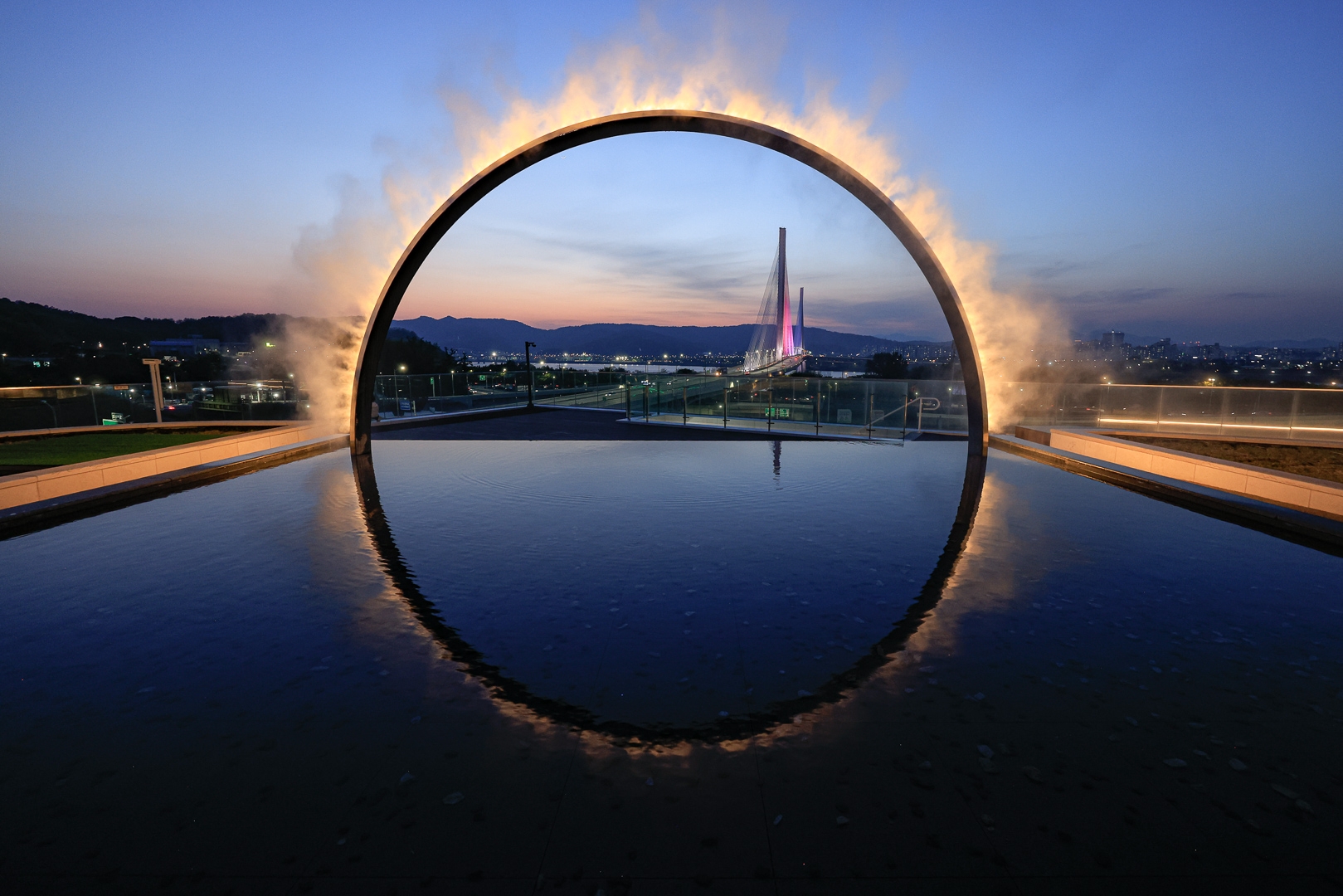
The project’s material restraint deserves recognition. The polished stainless steel could easily have become overly slick or self-conscious, especially in a luxury development context. Yet the ring, with its careful profile, does not seem designed to celebrate its own reflectivity. It acts more like a dark line drawn against sky and water, a boundary between the physical and the atmospheric. This is important. If the steel were too visually assertive, it would compete with the mist and reflection. Instead, it anchors them. The object is strong enough to hold the image, but quiet enough to let the phenomenon lead.
There is also a precise spatial intelligence in the way the work handles symmetry. The ring and its reflection create an almost perfect circle, but the surrounding world interrupts any sterile perfection. The bridge sits beyond it. The skyline stretches to the side. The mountains soften the horizon. Visitors appear at the edges. The pool holds traces of movement. The result is not a diagram, but a living composition. Geometry is used as a frame for contingency, not as an escape from it.
The project is not without limitations. Its strongest identity depends heavily on night activation. In daylight, the piece remains poised and formally coherent, but it does not carry the same metaphysical charge. The unlit version can feel closer to a refined urban sculpture than to a fully immersive environmental work. This is not a fatal flaw, since many artworks have temporal peaks, but the contrast is significant. The project reaches its fullest force only when light and mist are active. Its long term success will therefore depend on maintenance, calibration, and the continued sensitivity of its lighting system.
There is also the risk of excessive photogenic appeal. The glowing ring, mirrored pool, mist, bridge, and evening sky create an image of immediate visual seduction. In the current culture of rapid image circulation, this strength can become a liability. The work may be consumed too quickly as a photograph, its atmospheric subtlety reduced to a spectacular backdrop. The installation rewards patience, but not every viewer will grant it that time. This is less a fault in the work than a challenge facing many contemporary public artworks that must exist both as lived experiences and as circulating images.
A further concern lies in the delicate boundary between atmosphere and spectacle. When the balance is right, the mist reads as elemental, almost weather like. If pushed too far, it could slip toward theatrical excess. Too much brightness would flatten the mystery. Too much vapor would make the effect literal. Too little would leave the arc undercharged. The work lives in nuance, and nuance requires care. Its success depends not only on design intent, but on precise ongoing control.
These reservations, however, do not weaken the overall achievement. They simply identify the fragile conditions that make the project so compelling. “Arc ZERO: Eclipse” is powerful because it does not rely on mass, complexity, or narrative explanation. It trusts a few elemental relationships and allows them to deepen through experience. The half ring is completed by reflection. The steel is softened by mist. The city is reframed by geometry. Light turns an object into an event.
In the end, “Arc ZERO: Eclipse” is not merely a lighting installation, nor is it simply a sculpture with lighting effects. It is a carefully tuned encounter between built form and natural phenomenon. Its most persuasive moments occur when the viewer can no longer separate the designed from the atmospheric. The ring appears to hover, the water appears to think, the mist appears to glow from within, and the city beyond seems momentarily transformed into a distant world. On a rooftop in Seoul, Tapscott has created a controlled impossibility: a circle that is only half built, a fire that is not fire, a portal that opens nowhere and yet changes the place entirely.