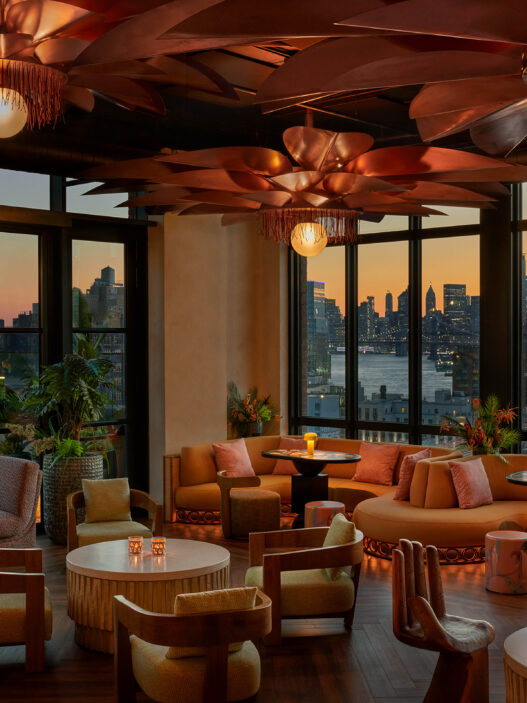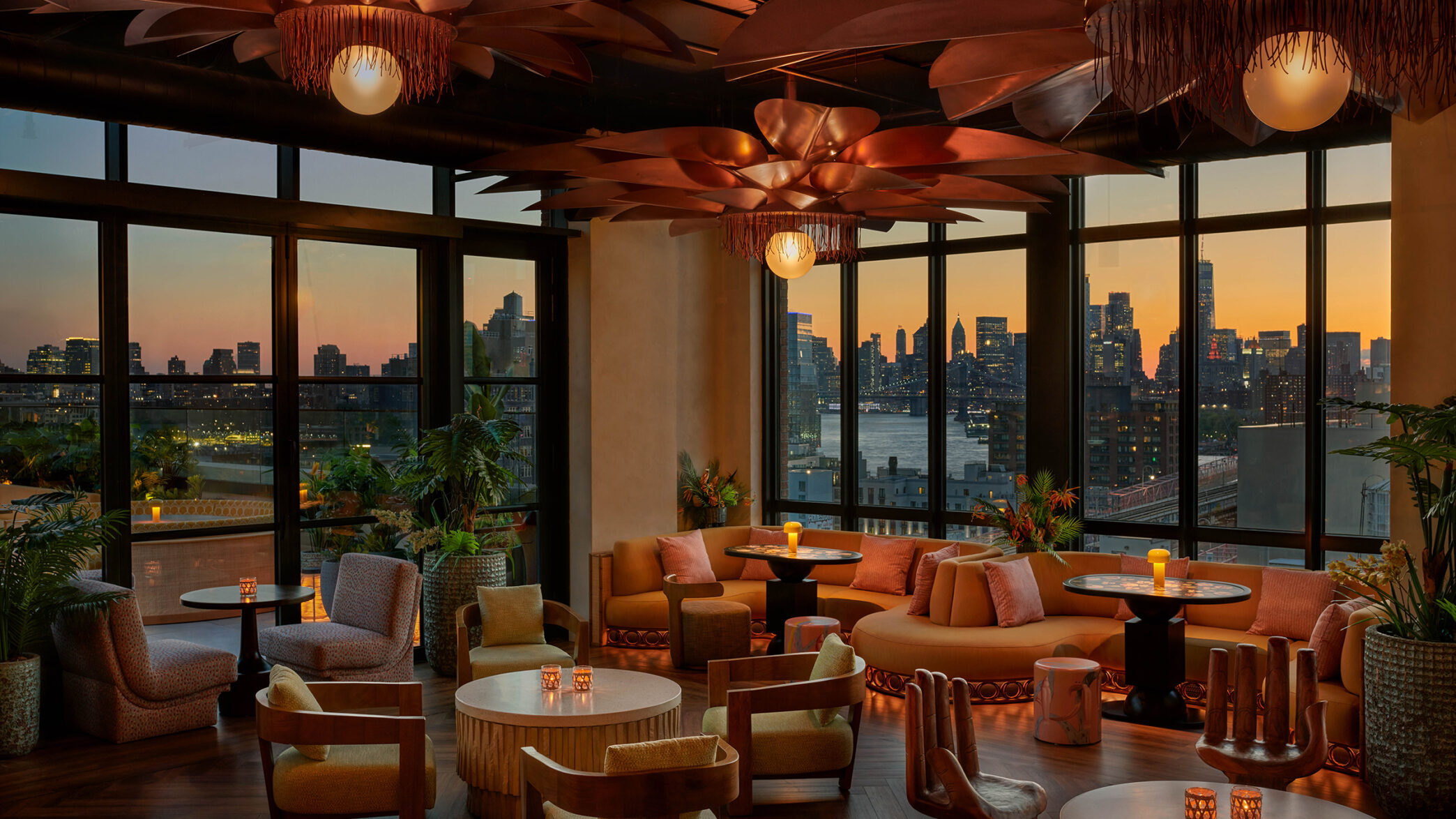













Dusk does something specific to the glass here, and the design seems to have been built around that specific hour. Beyond the curtain wall the sky still holds its last cobalt, and against it an amber bar top curves away into a low golden fire that has nothing to do with flame. A run of concealed LEDs sits behind the onyx, pressed close enough to the stone to pass light through its own veining, but no explanation of the fixture changes what the body registers at the threshold: warmth rising from a surface that should, by every rule of a countertop, be cold to the touch.
Brand: 18Fifty
Lighting Designer: Evina Diamantara
Architecture Company: OIR
Interior Design Company: MBDS
Location: Dubai, UAE

Arrival happens before any door opens, and it happens as a lighting decision first. A reception desk in dark lacquer and bronze sits in a shallow nook, lit from a recessed strip at floor level that throws a warm, low-angle wash up the front of the stone, not down onto it, an uplighting choice that keeps the desk legible without putting a single visible downlight over the host’s head. Above it, a wall built from cast coral and shell is lit on an entirely different circuit and, by the look of it, at a cooler color temperature: a close, even wash, not a single spotlight, angled to graze the surface and not flood it. Grazing light, struck at a shallow angle across a textured plane, reads the ridges and cavities of a material by throwing tiny shadows off every raised edge; a flat, frontal wash would erase exactly that texture and flatten the reef into a colored poster. The choice here is a graze, and it is the correct one for a surface whose entire value lies in relief, not color alone. The two circuits, warm below and cooler above, are never blended into one wash, which means a guest’s eye receives two distinct signals, body-level warmth and sculpture-level clarity, without either system needing to dominate the other. 
The technique behind that wall deserves a slower look than most guests will give it in passing. Coral and shell forms carry an unusually wide range of natural color within a small area, pale coral pink sitting inches from deep ochre and cobalt, and a light source with poor color rendering will flatten that range into a muddier average, the way a cheap bulb turns a bowl of fruit into a single brownish mass. Whatever is lighting this wall is doing the opposite: every individual form keeps its own hue distinct from its neighbor, which suggests the fixtures were chosen and aimed with real attention to how they render saturated, closely spaced color, not just how bright they read from a distance. That is a specific, testable technical decision, and one easy to get wrong on a dense, sculptural surface like this one.

Moving along the window wall, fluted columns in a deep coral pink glow from within, their ribbed surface catching internal light and breaking it into vertical strokes, not unlike a pipe organ rendered in warm resin. These are Murano glass, shaped to suggest coral or tentacle form, and they establish a second plane of light set back from the seating, so that looking down the length of the counter takes in not only the near light of the bar but a receding rhythm of pink verticals stretching toward the horizon of glass and skyline. This is pacing in the specific sense a lighting designer means the word: a sequence of illuminated moments spaced to draw the eye along a long, faintly serpentine run without the aid of a single obvious sightline. The floor plan bends, and the columns compensate for that irregularity by giving the eye regular beats to follow, one after another, until the rhythm dissolves into the window and the city beyond it.

The backlit golden onyx bar functions as the central spatial element. Its scale, position, and luminous quality create a strong focal point, drawing attention through material depth rather than intensity alone. Onyx has a particular relationship with light because its value is discovered through transmission. The stone reveals variations hidden under ordinary conditions, and the lighting design takes advantage of this characteristic. The result depends on balance: sufficient luminance to expose the material’s internal structure, with enough control to preserve the richness of the stone.
This approach demonstrates an understanding of material behavior. Light does not treat every surface equally. A reflective surface requires different handling from a translucent stone, and a textured wall demands a different relationship from a smooth architectural plane. The project’s strongest moments emerge where the lighting responds to these differences rather than applying a uniform visual system throughout the space.

Further along, the fixture logic shifts accordingly. Overhead, a row of crystal chandeliers hangs low and close together, and their real function is not illumination in any meaningful photometric sense: each shade is small and each lamp source is dim. Their job is sparkle. The faceted glass catches and scatters what little light passes through it, producing a field of small specular highlights, not useful foot-candles on any working surface below. This is a classic layering decision, with ambient fill handled elsewhere while the chandeliers do decorative, glare-free glitter work at a brightness low enough that none of it competes with the walls. The fluted Murano columns, meanwhile, are backlit, not surface-lit, meaning the light source sits behind or within the material and is not aimed at its face; the ribbed profile of the glass breaks a single internal source into a run of vertical highlights and shadow troughs, so one continuous lamp reads as a rhythm of separate strokes. By day, or in slower service, these columns hold a warm, fixed color temperature; later, the same fixtures are switched to an RGBW system capable of additive color mixing, cycling into more saturated hues as the room’s pace picks up. Running one physical column on two entirely different lighting programs, tied to time of day and not to any change in the architecture, is an efficient piece of control logic, since it multiplies the atmospheric range of a single fixture position without adding a luminaire to the ceiling. Whether each column is addressed as one solid color at a time or broken into individually controllable pixels along its height changes what the effect can do: a single-color run reads as mood, uniform and architectural, while pixel-level control would allow color to travel up or down the glass, a genuinely different visual event built from the same hardware. From what the columns show in their steadier state, the emphasis here favors the former, a calmer, more controlled use of a system that could, in principle, be pushed toward something busier.

The corridor opens into a wider gathering point built around a full circular bar, and the lighting vocabulary compresses along with the architecture. The backlit amber counter here reads brighter and more concentrated than the run along the windows, a genuine contrast-ratio decision: the same lighting budget is gathered into a tighter circle, not spread along a long horizontal run, which raises the apparent brightness at the room’s center relative to its perimeter and pulls the eye inward the moment a guest steps through the doorway. Overhead, a school of pale glass fish hangs at varying heights, and the fixtures are aimed to wash the group from below and around, not to give each form its own embedded LED point, letting the cloudy, faintly luminous glass itself scatter and hold that ambient light. This is a meaningfully different technique from the backlighting used on the bar and the Murano columns: those are lit from behind a solid or semi-solid material to create a glow through it, while the fish are lit from without and rely on internal scattering within translucent glass to look luminous, not just reflective. At the bar’s edge, a bronze or verdigris mermaid figure is uplit from a single source positioned low and close to the base,