





Light Moving Between Colors
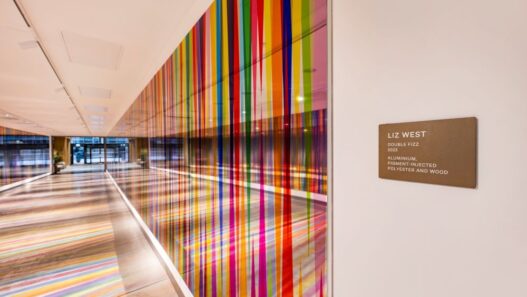
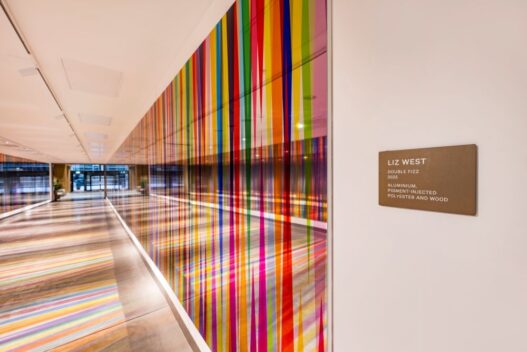
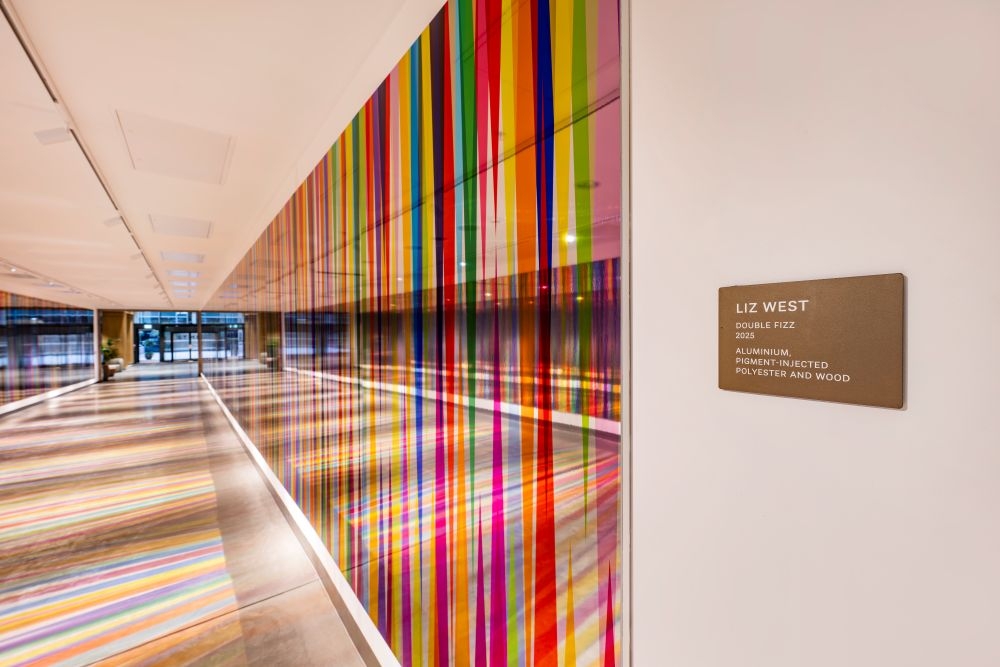
A corridor is usually the part of a building that people agree to forget. It gets them somewhere, keeps circulation moving, satisfies the requirements of a plan, and then disappears from memory. In Double Fizz, Liz West takes that condition and fills it with an optical event. The walls carry thousands of vertical triangular polyester-vinyl stripes against mirrored surfaces, while the floor catches their color in long, broken reflections. Light enters the scene through the building’s architectural lighting system, and the boundary between illumination and surface becomes deliberately unstable.
That instability is where the project becomes interesting as a lighting work.
Designer; Liz West
ArtConslt: RuthDavies
Fabricator: M3Industries
Developer: Relentless
LightingSupplier: formalighting
Location; Manchester, UK


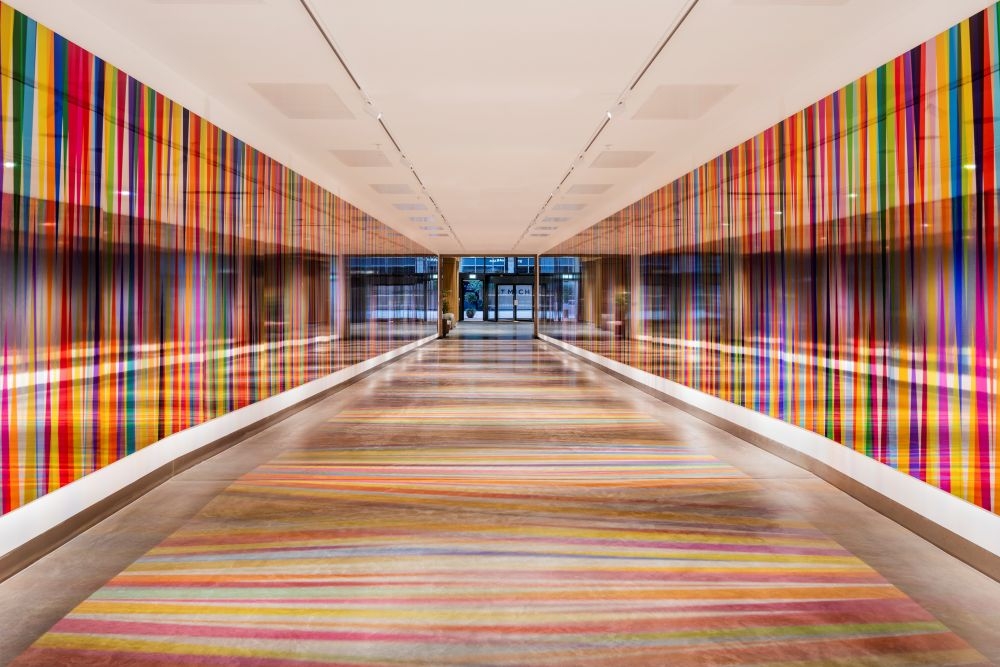
Looking closely, the first thing I notice is that the light itself is remarkably controlled. The ceiling remains largely white and quiet. Recessed elements, linear architectural lighting, and adjustable fixtures are visible along the circulation route, producing an even level of illumination through the corridor. There is no theatrical darkness surrounding the artwork, no dramatic beam aimed at a particular section, no obvious attempt to turn the passage into a conventional light installation. The architecture retains its visual legibility. Stairs remain visible, the floor remains readable, and the corridor can still function as a circulation space.
The color, however, behaves as if it has escaped the ceiling.
This distinction matters. The color originates in the vertical stripes and their mirrored reflections. The lighting system provides the conditions under which those surfaces can be seen, repeated, reflected, and carried visually across the architecture. What appears at first glance to be a lighting spectacle is therefore heavily dependent on material, reflectance, color, viewing angle, and movement.
That is a much more sophisticated relationship with light than simply placing colored fixtures into a corridor.
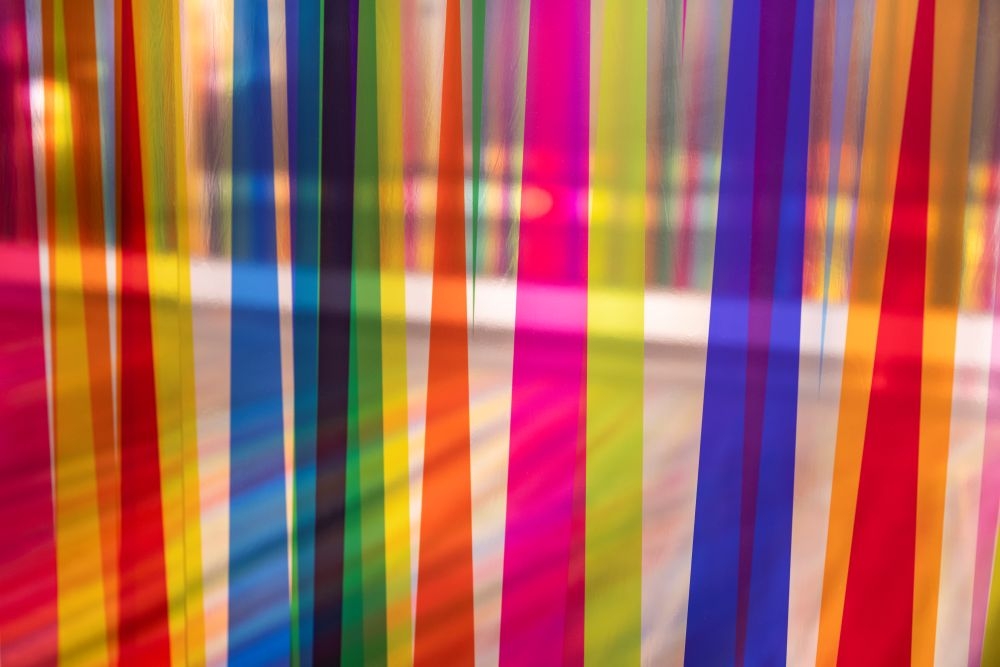
West’s decision to work with vertical stripes gives the installation its particular optical rhythm. The stripes are narrow, irregular in width, and densely accumulated. They do not form a conventional image. There is no single focal point for the eye to settle on. Instead, the gaze travels laterally and vertically, repeatedly interrupted by reflections. The mirror doubles the material and produces an environment in which color has no stable edge. A red stripe becomes part of a reflection; a green field breaks into neighbouring tones; white architectural surfaces become temporary carriers for color.
The lighting has an important role here because the installation requires sufficient illumination to reveal the physical surface while allowing the mirror to remain optically active. Too little light would reduce the work to a dark reflective wall. Excessive directional illumination would introduce bright hotspots and competing highlights. It allows the corridor to remain usable while giving the artwork enough visual presence to occupy the field of view.
There is also something revealing in what the lighting refuses to do.
The ceiling fixtures do not appear to compete with the stripes. Their geometry is relatively conventional, and their visual presence is secondary. For a lighting designer, this is an important lesson in restraint. The installation already possesses an enormous amount of chromatic information. Adding colored sources, dramatic contrast, animated effects, or aggressive accent lighting could easily push the environment into visual excess. The existing approach allows the material to perform most of the optical work.
That restraint, however, comes with a cost.
The lighting design is difficult to isolate as an authored layer of the project. We can see the result of the lighting, but we are given limited evidence of a distinct lighting strategy beyond providing architectural illumination for the corridor and supporting the artwork. The project information identifies Formalighting as the lighting supplier, while the sustainability statement refers to energy-efficient lighting. It does not provide measurable lighting criteria, fixture specifications, color temperature, illuminance levels, control strategy, or information about how the lighting was calibrated against the reflective surfaces.
That absence matters when the work is considered specifically as lighting design.
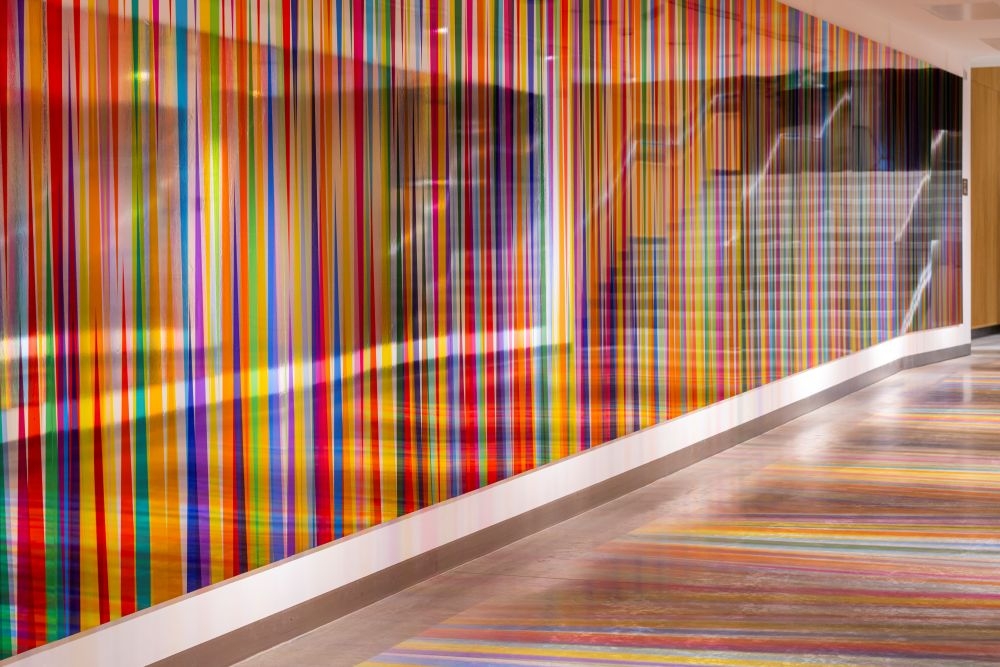
A strong lighting installation can be understood through what happens to light after it encounters a surface. Double Fizz is particularly dependent on that encounter. The mirror is effectively an optical amplifier. Every vertical stripe gains another visual life through reflection, and the corridor begins to contain color that appears to come from several directions at once. The floor becomes especially important. The effect creates a continuous visual field between vertical and horizontal planes.
The evidence supports a more careful reading: the color appears to emerge through the interaction of the striped surfaces, their reflections, the polished architectural finishes, and the existing illumination. That distinction is worth preserving because it changes how the work should be evaluated. The achievement is less about a lighting fixture producing an effect and more about constructing an environment in which ordinary architectural light becomes capable of producing an unusually complicated visual response.
This is where West’s broader practice becomes relevant. The project description places her work across sculpture, architecture, design, painting, and light. Double Fizz makes that crossing unusually literal. The physical object is almost inseparable from its optical behavior. The installation does not sit inside the corridor as a picture hanging on a wall. It reorganises the way the corridor is perceived.
Before the intervention, the main artery of the development would have been understood primarily through architecture: floor, ceiling, walls, circulation, thresholds, stairs, and the movement of people. After the installation, those same architectural components become part of a chromatic field. The wall is no longer simply a boundary. The mirror turns it into an active visual surface. The floor is no longer simply a plane for movement. It becomes a receiver of reflected color. The ceiling remains relatively neutral, and precisely because of that neutrality, the saturation below it becomes more legible.
This is perhaps the most consequential identity given to the space through lighting.
Light does not define the corridor through a new object. It changes the status of the existing surfaces.
There is a particularly effective tension between the permanence of the installation and the fleeting nature of its visual effects. The stripes are fixed. The mirrors are fixed. The fixtures are fixed. The color experienced by a person moving through the corridor is not. Perspective changes the reflections. Walking alters the apparent density of the stripes. The mirrored surfaces introduce fragments of color that seem to shift as the observer changes position.
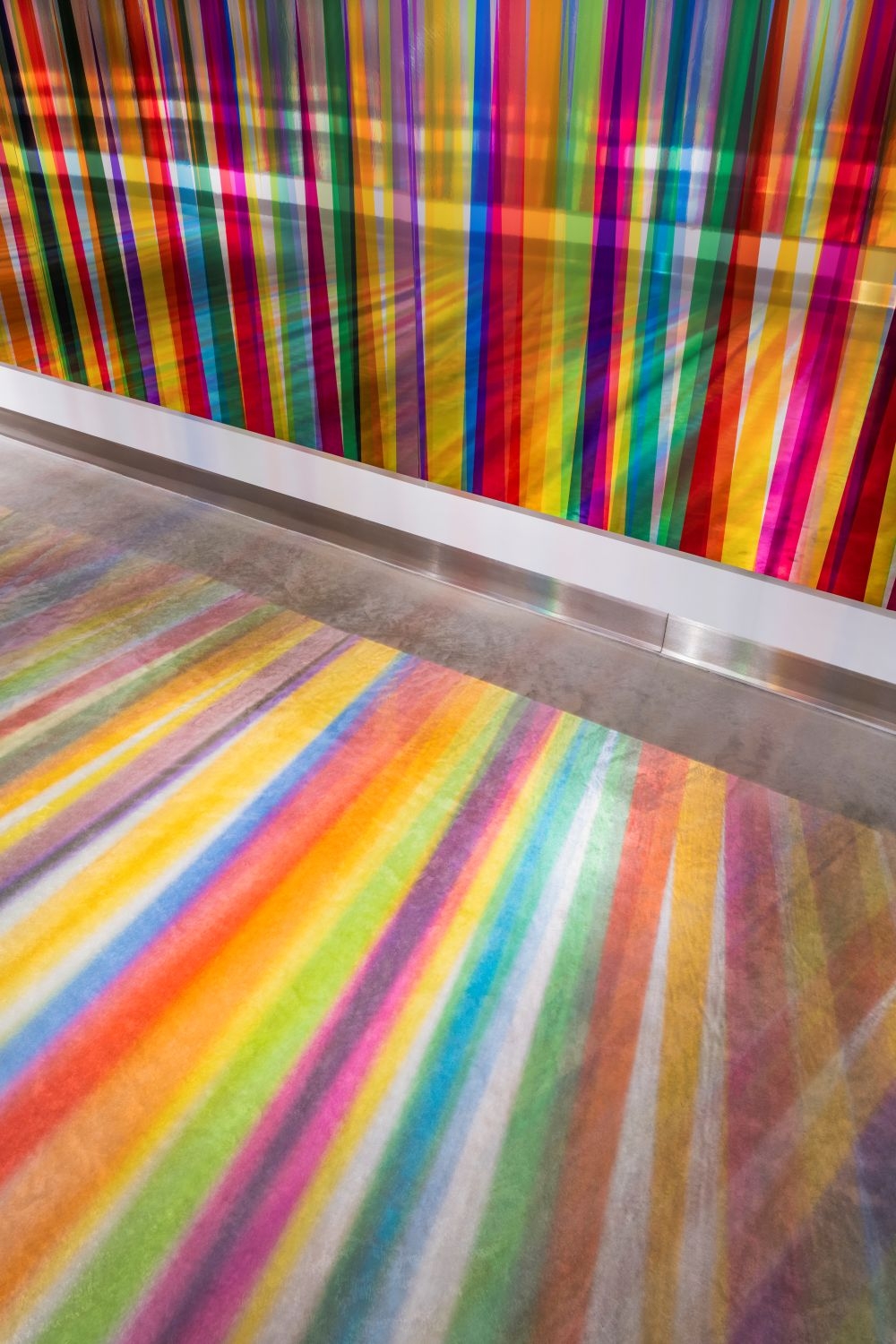
The project therefore depends on movement without requiring mechanical movement.
That is a useful distinction in contemporary light art, where motion is often introduced through programmed media, LEDs, projection, or kinetic systems. Here, the visitor supplies the movement. The installation remains physically still while perception does the work. A person walking through the corridor becomes part of the optical mechanism, even if the architecture itself never acknowledges that person explicitly.
There is another detail worth examining: the verticality of the artwork against the horizontal movement of the corridor.
The building asks people to move forward. The stripes ask the eye to move across and up and down. The mirror multiplies both directions. This creates a perceptual friction that gives the corridor its character. The lighting maintains enough consistency for the body to understand the route while the artwork continually disrupts visual certainty. The visitor can walk through the space without losing orientation, yet the visual environment refuses to settle into a single reading.
That balance is valuable because a public circulation space cannot be designed entirely around visual spectacle. It has practical obligations. People need to see changes in floor level, stairs, edges, doors, other occupants, and the direction of travel. A highly reflective environment also introduces concerns around glare and visual fatigue. For a short encounter, this can be exhilarating. For people who work, pass through, or spend extended periods in the development, the same density becomes a question of comfort.
The installation therefore succeeds most clearly when understood as an encounter along a route, not as an environment that needs to maintain maximum intensity at every point.
The lighting contributes to that possibility through its relatively even architectural distribution. It does not appear to force the visitor into a prescribed viewpoint. The work changes as the viewer changes position. In the close view, the stripes lose their architectural scale and become almost abstract optical matter.
The camera also reveals something that a person standing still might miss: the installation contains a considerable amount of visual noise. That is intentional, yet it is not automatically a virtue. The word “fizz” in the title describes the sensation accurately. The surfaces accumulate color until individual elements begin to dissolve into a larger optical mass. At certain distances, the stripes stop reading as separate pieces and start behaving as a continuous texture.
This is where the project walks a fine line.
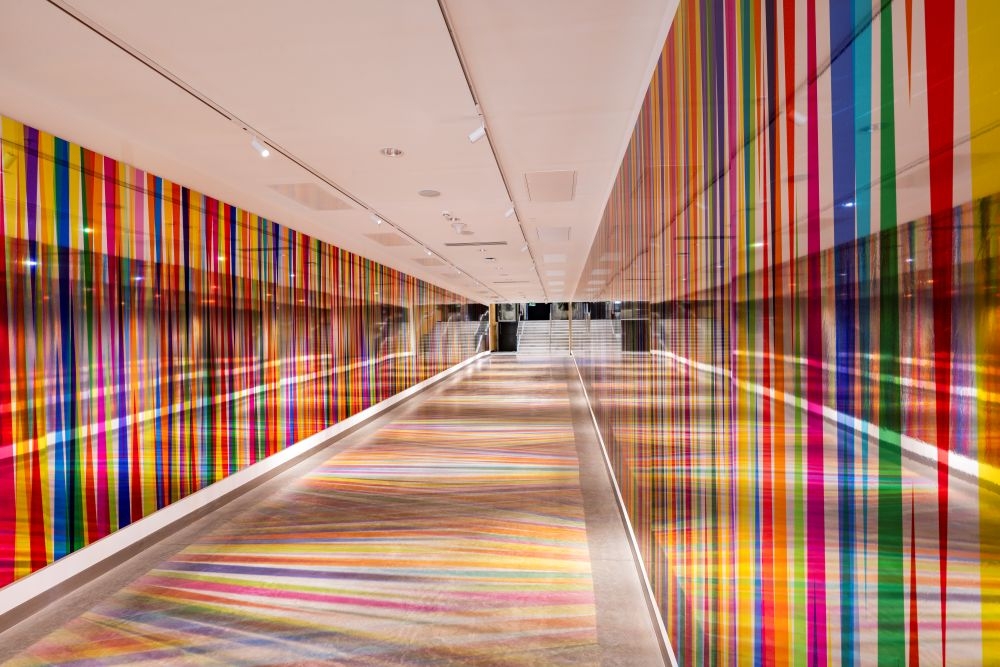
Its success depends on maintaining enough distinction between the individual colors for the eye to recognise rhythm, while allowing enough optical overlap for the field to become unstable. The mirror intensifies that condition. It does not simply reproduce the artwork; it complicates it. Every reflection introduces another layer of information, and the lighting determines how clearly those layers survive.
The sustainability argument deserves the same level of scrutiny. The project states that polyester vinyl was selected for durability and longevity in a high-traffic environment, while the permanent installation avoids some of the carbon consequences associated with dismantling and transporting temporary work. Those are reasonable considerations. The lighting is also described as energy-efficient. Still, the information provided does not quantify the lighting energy demand, operational schedule, expected maintenance cycle, material embodied carbon, or end-of-life strategy. For a permanent installation of this scale, longevity is meaningful, yet longevity alone does not establish a complete environmental assessment.
There is also an operational question hidden inside the visual success of the work. A mirrored, intensely colored surface in a public circulation route will inevitably collect fingerprints, dust, scratches, and traces of use. The more visually exact the reflective field needs to remain, the more visible maintenance becomes. The material choices are presented as durable, and that is relevant, though the long-term optical performance of the mirrors and vinyl will ultimately determine whether the original lighting relationship survives years of public occupation.
This is where Double Fizz becomes more compelling than its immediate visual seduction suggests. Its real subject is not color alone. It is the behavior of a building once its surfaces are given permission to participate in the lighting environment.
The architectural lighting establishes visibility. The colored material establishes chromatic information. The mirrors multiply it. The floor receives it. Movement reorganises it. The viewer completes the sequence simply by walking.
That chain of decisions gives the installation its strongest quality.
There is no need for the lighting to announce itself as a separate spectacle. Its contribution is embedded in the conditions that allow the artwork to operate. At the same time, the relative conventionality of the visible lighting system leaves the authorship of illumination somewhat indistinct. If the project is presented primarily as light art, that distinction should remain part of the discussion. The extraordinary visual result belongs to the interaction of art, material, architecture, reflection, and illumination. Assigning the entire effect to lighting would flatten what is actually a more complex construction.
What remains after the initial shock of color is therefore quite precise: a circulation space whose surfaces have been made optically active. The lighting gives the work enough clarity to function in an inhabited building, while the reflective installation converts that illumination into something that appears to travel. The corridor keeps its practical geometry, yet its visual identity has been fundamentally altered.
Double Fizz does not need the architecture to disappear. It needs the architecture to become perceptually unstable for a few seconds at a time. That is what the lighting ultimately makes possible. The most successful moments occur when the visitor can still read the building while simultaneously losing confidence about where the color begins, where the reflection ends, and which surface is actually carrying the light.
In a project built from thousands of fixed stripes, that uncertainty is the part that moves.