







On the evening of December 2, Abu Dhabi did not simply inaugurate a building. It staged a carefully calibrated encounter between architecture, light, music, and national memory. The official opening of the Zayed National Museum, aligned with the 54th Eid Al Etihad celebrations, unfolded less as a ceremonial ribbon-cutting and more as a civic performance, one in which lighting design assumed a central narrative role. The museum, conceived by Foster + Partners as a cluster of monumental falcon-wing forms rising from Saadiyat Island, became both stage and storyteller, its surfaces activated by light to articulate a history that is at once personal, political, and collective.
Editor’s Note:
On December 2, Zayed National Museum was introduced to the public through a carefully orchestrated sequence of light, music, and architectural presence. The opening marked not only the inauguration of a cultural institution, but a moment in which lighting design became integral to how the building, its symbolism, and its civic role were first experienced at scale.
The following text reflects on that evening as a constructed spatial event, where light operated across architecture, performance, and landscape to shape perception and meaning. The focus remains on how lighting contributed to the formation of atmosphere, narrative continuity, and public memory during the museum’s unveiling.
editor-in-chief
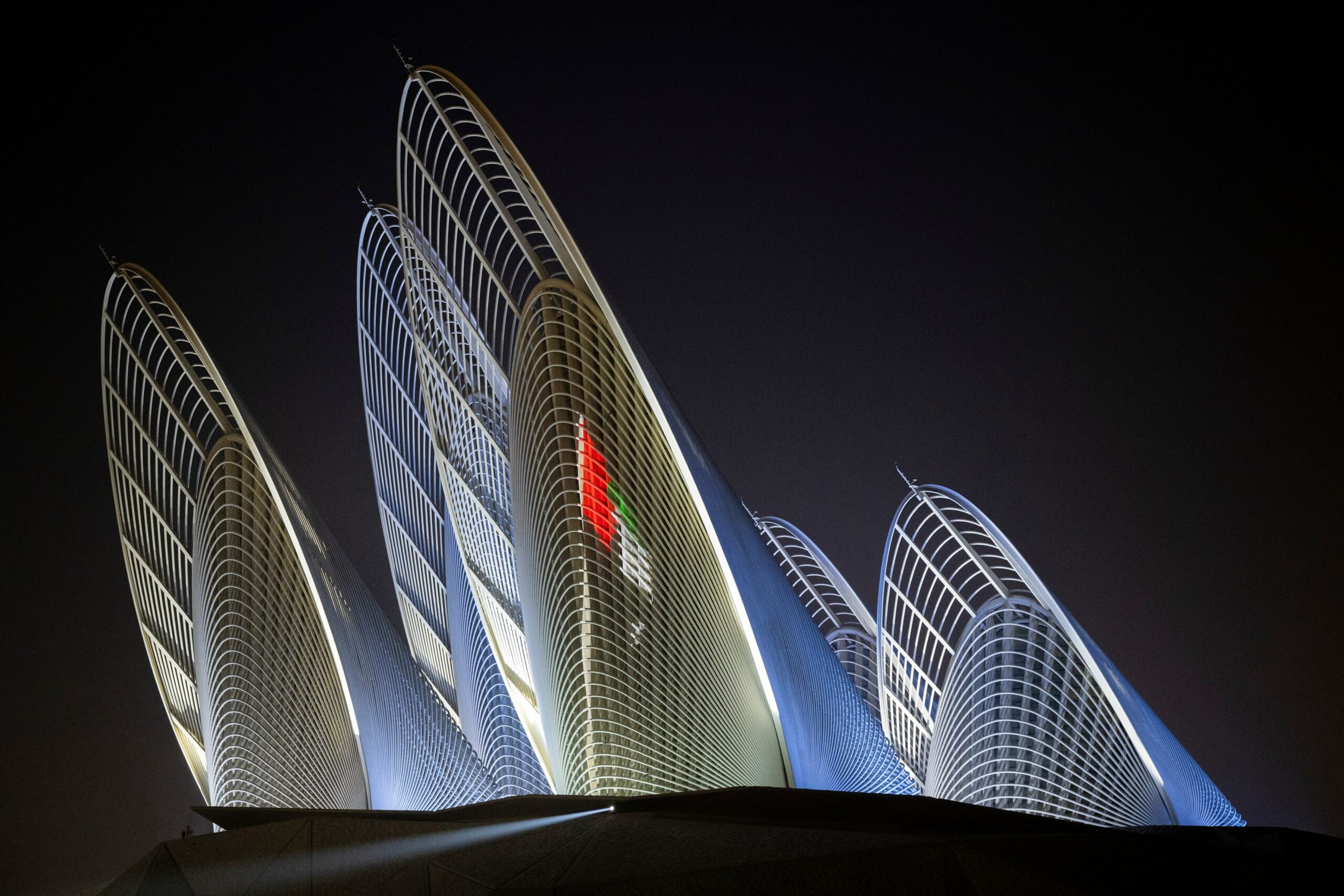
The architectural language of the museum is already laden with symbolism. The falcon, a potent emblem in Emirati culture, is rendered here at an almost geological scale, its wings abstracted into tapering vertical structures that modulate light and air. By day, the building reads as a sculptural landscape; by night, it becomes a canvas of immense potential. The challenge for the lighting team was not merely to illuminate an iconic form, but to choreograph a visual narrative that could speak to heritage without lapsing into spectacle for its own sake.
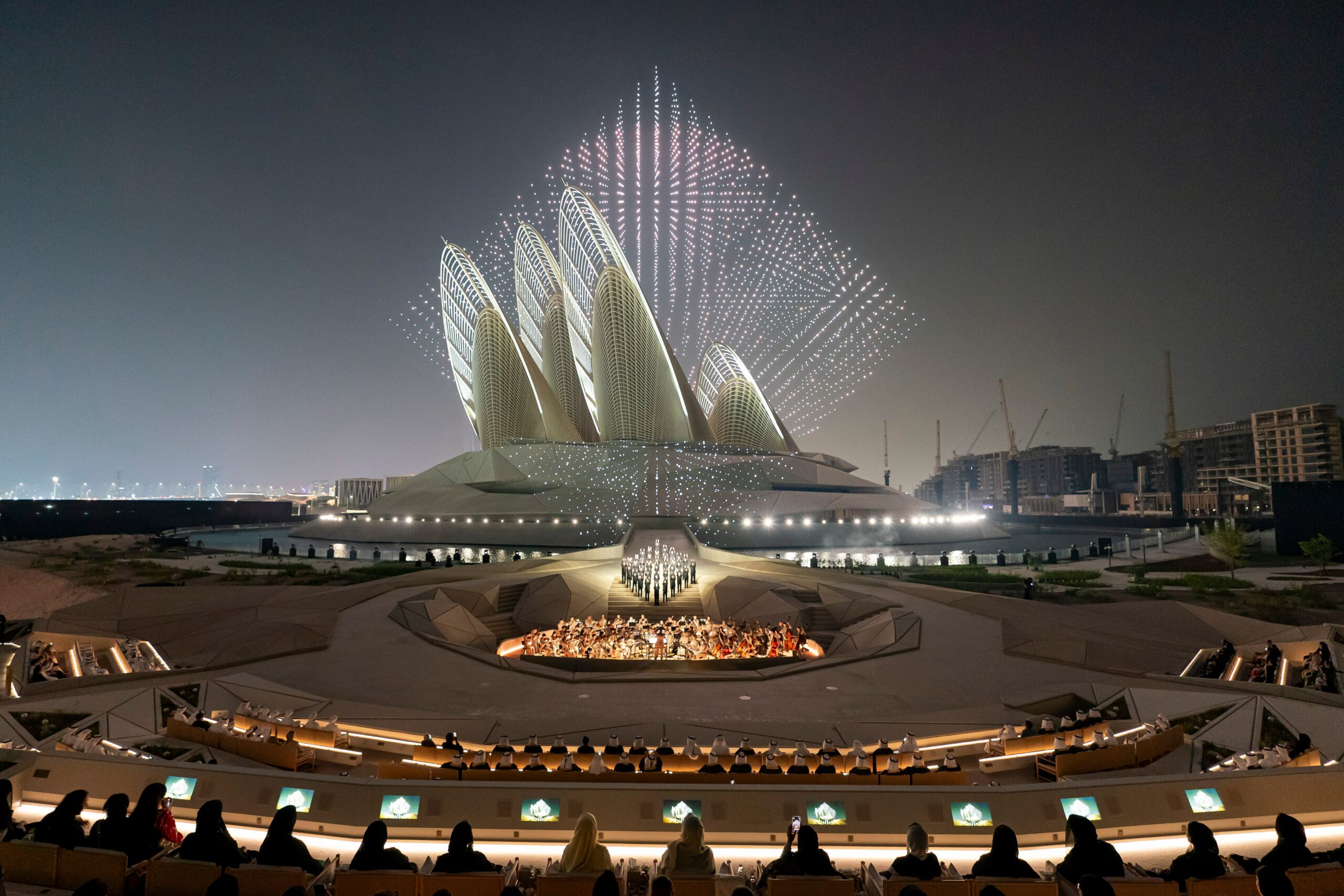
The unveiling ceremony embraced this challenge with a layered lighting strategy that operated simultaneously at architectural, performative, and emotional registers. The museum’s exterior lighting was not treated as static illumination, but as a dynamic system capable of transformation. Carefully positioned luminaires traced the geometry of the falcon wings, emphasizing their verticality and rhythm, while a restrained palette of warm whites and ambers grounded the building in a sense of permanence and dignity. Against this stable architectural base, projection mapping and large-scale light content introduced movement, texture, and narrative progression.
The projected light show, designed to align with the cultural arc of the evening, did not overwhelm the architecture. Instead, it appeared to emerge from it. Light flowed across the wings as if carried by wind, revealing patterns inspired by desert landscapes, archival imagery, and abstracted motifs drawn from Emirati history. The scale of the projections demanded technical precision, but their success lay in restraint. Brightness was carefully controlled, contrast calibrated to preserve the legibility of the architectural form beneath. The building remained present, never dissolving into pure image.
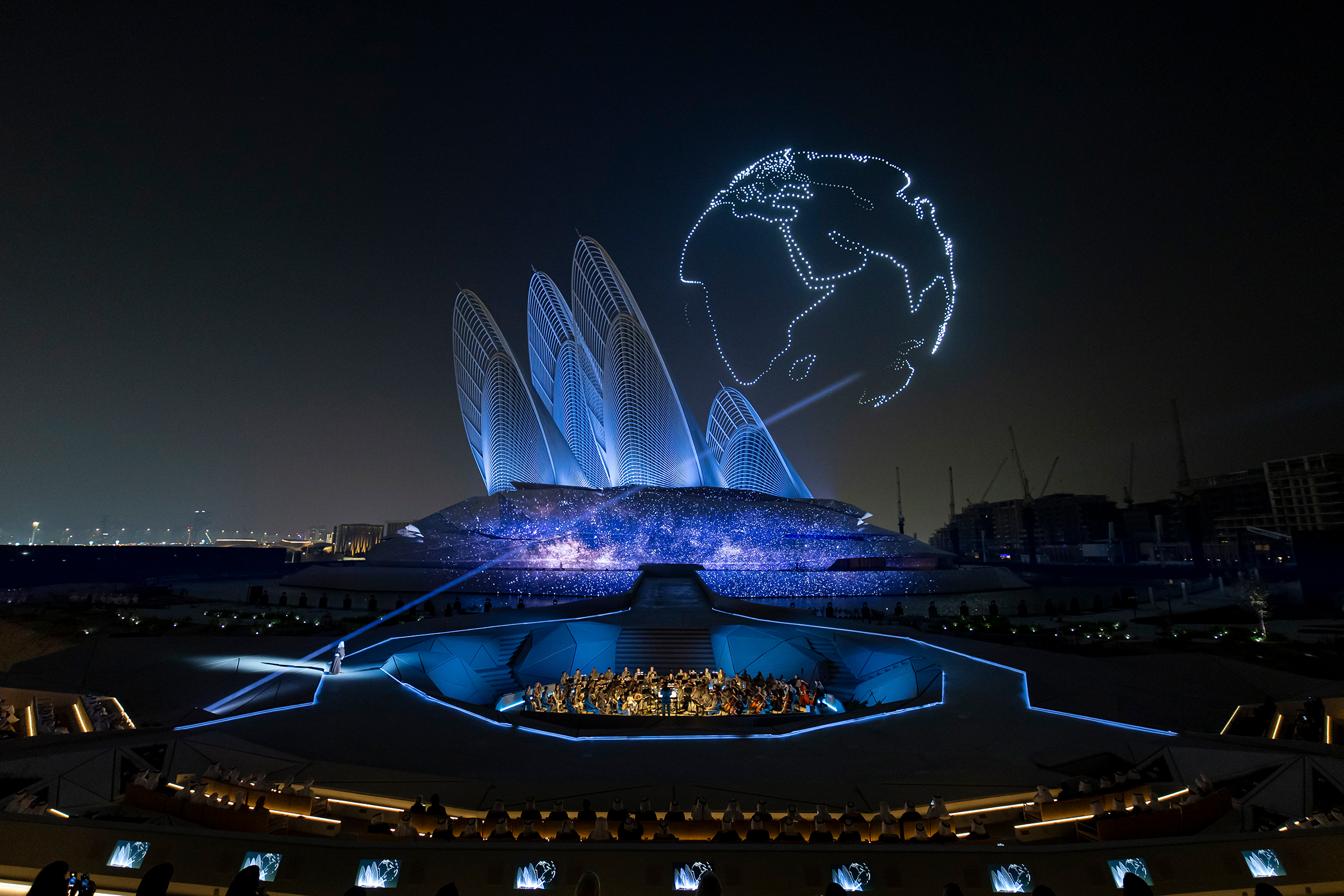
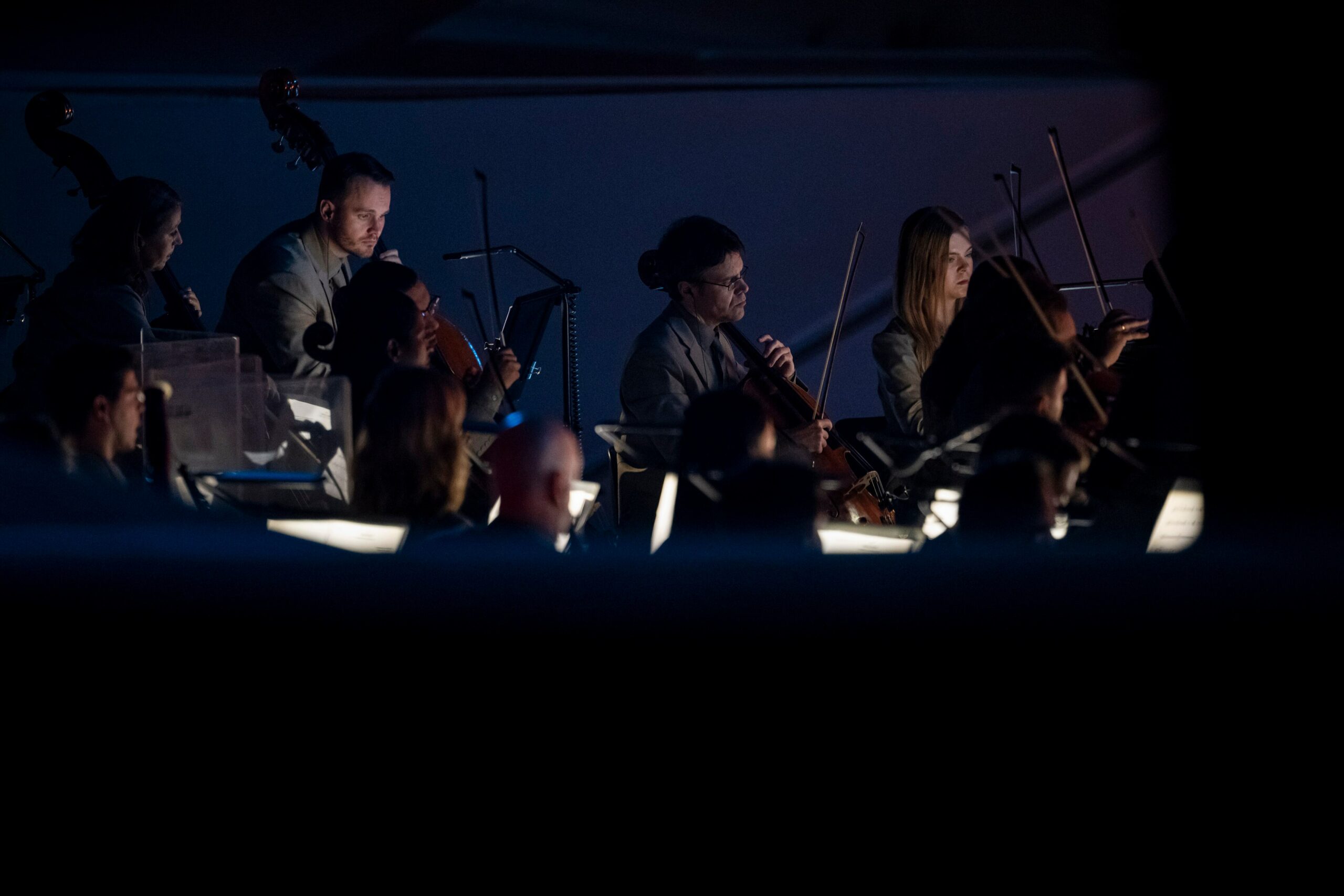
At the heart of the ceremony was the debut public performance of the UAE National Orchestra, whose placement at the base of the structure created a powerful spatial dialogue. The orchestra occupied a semi-subterranean performance area, framed by stepped seating and illuminated with a softer, more intimate lighting language. Here, light shifted function. It no longer spoke to monumentality, but to human presence. Warm, directional lighting defined the musicians and conductor, establishing visual focus without severing the connection to the illuminated architecture above. The audience’s gaze was constantly invited to travel between the performers and the towering wings beyond, reinforcing the idea that cultural heritage is sustained through both legacy and living practice.
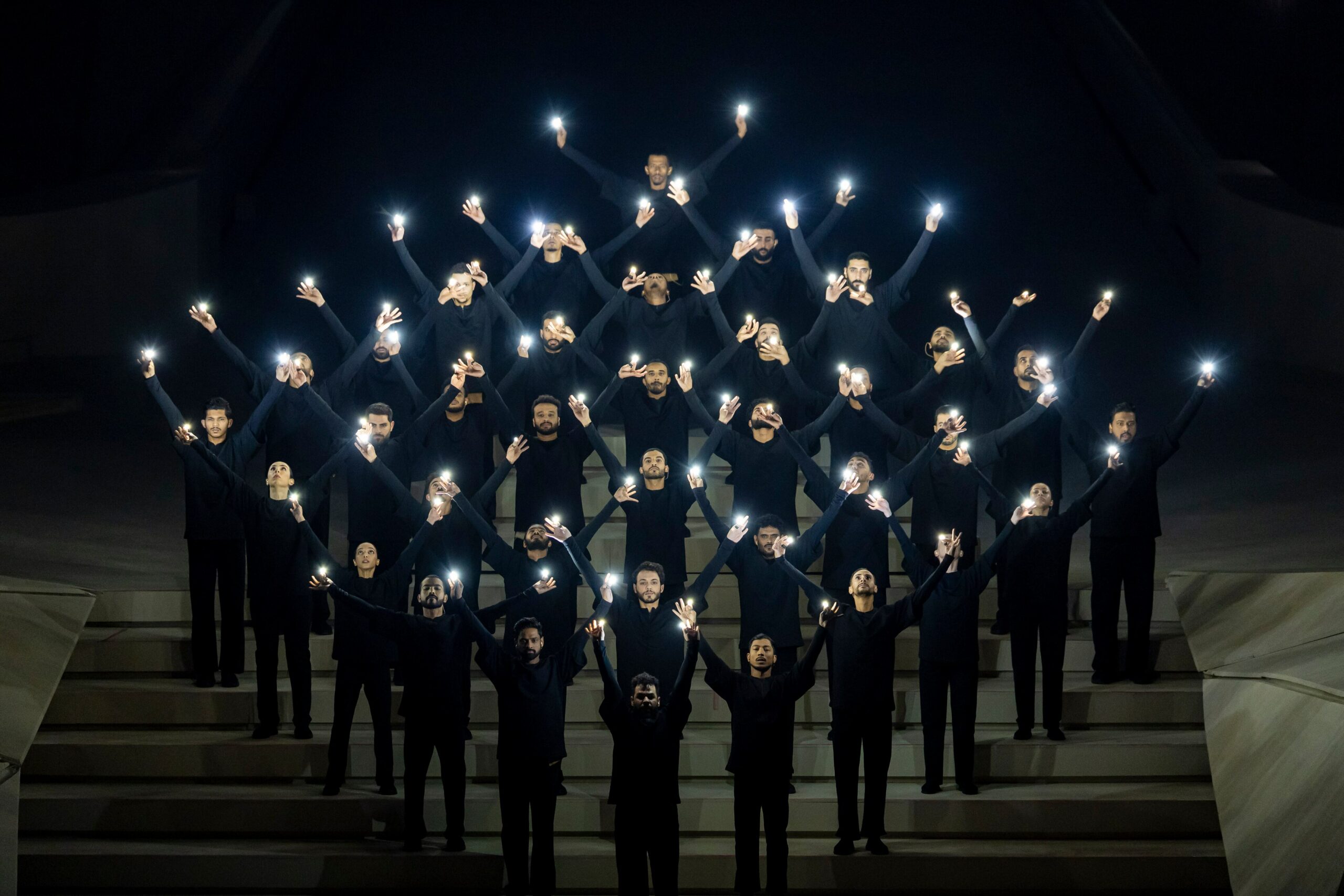
Bruno Poet’s lighting design for the event demonstrated a deep sensitivity to this duality. Known for his ability to balance theatricality with architectural respect, Poet approached the museum not as a backdrop, but as a collaborator. The lighting cues were paced with musical and choreographic elements, allowing moments of stillness to coexist with sequences of heightened visual intensity. Light was allowed to breathe. Darkness was used deliberately, creating pauses that sharpened attention and prevented visual fatigue.
The integration of drones added another dimension to the lighting narrative. Rather than functioning as a novelty, the aerial elements were deployed with compositional discipline. Their illuminated formations echoed themes introduced on the building’s surface, extending the visual field upward and outward. This vertical expansion reinforced the museum’s role as a cultural anchor, not confined to its footprint but radiating meaning into the surrounding urban and celestial space.
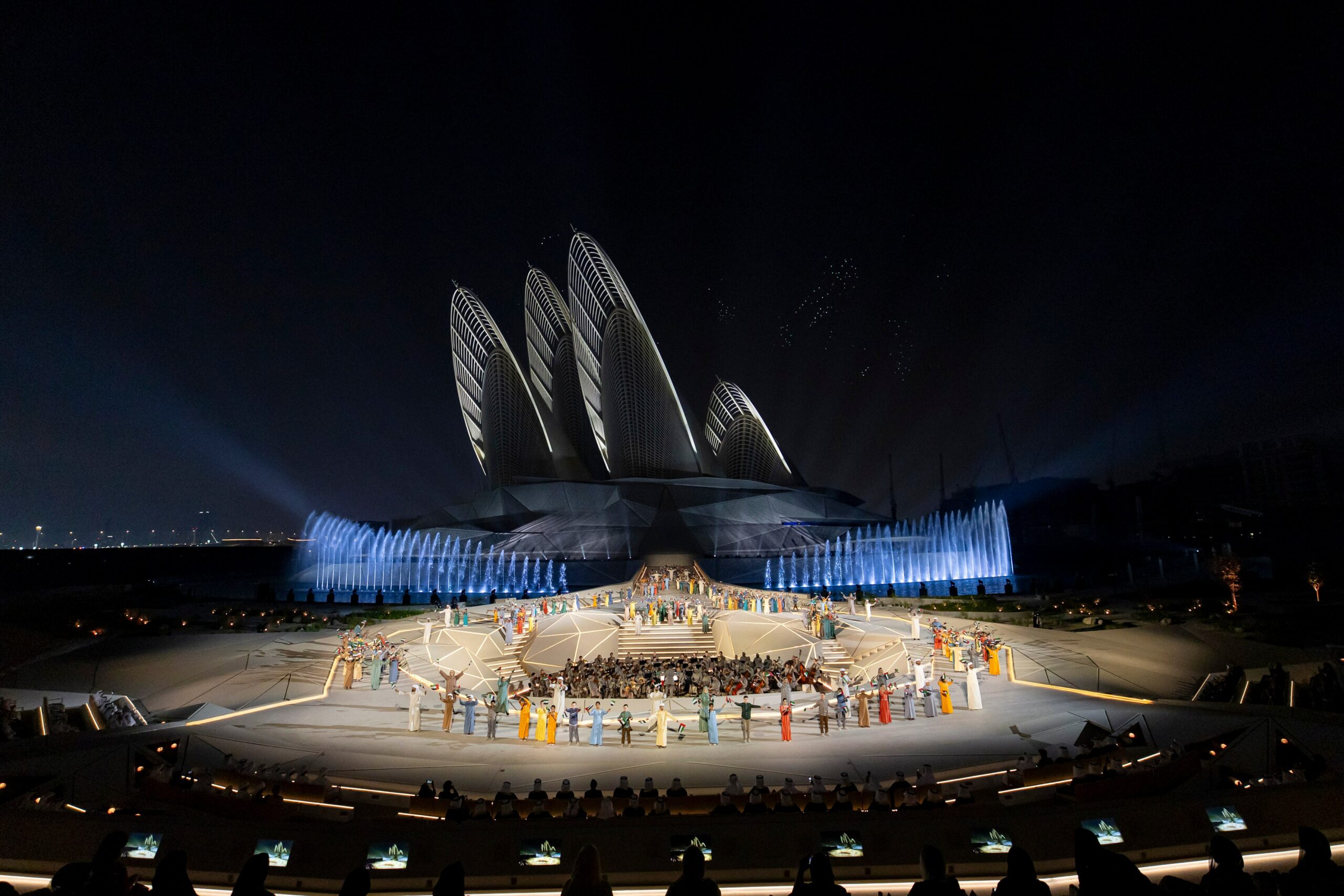
Behind the scenes, the complexity of the lighting operation was immense. A combination of high-performance fixtures from Robe Lighting, SGM Lighting, and Ayrton Digital provided the flexibility required for both architectural wash and precise accent. Control systems by MA Lighting International enabled seamless transitions between static states and dynamic sequences, ensuring synchronization across multiple layers of light, projection, sound, and movement. The technical execution was invisible in the best possible way. What remained visible was coherence.
What distinguished the lighting design of the Zayed National Museum opening was its refusal to treat light as mere ornament. Instead, light functioned as an interpretive medium. It translated architectural intention into emotional experience. It bridged the historical narrative of Sheikh Zayed bin Sultan Al Nahyan with a contemporary language of technology and performance. The museum’s role as a repository of national history was thus mirrored by the lighting’s role as a carrier of memory, illuminating not just surfaces, but values.
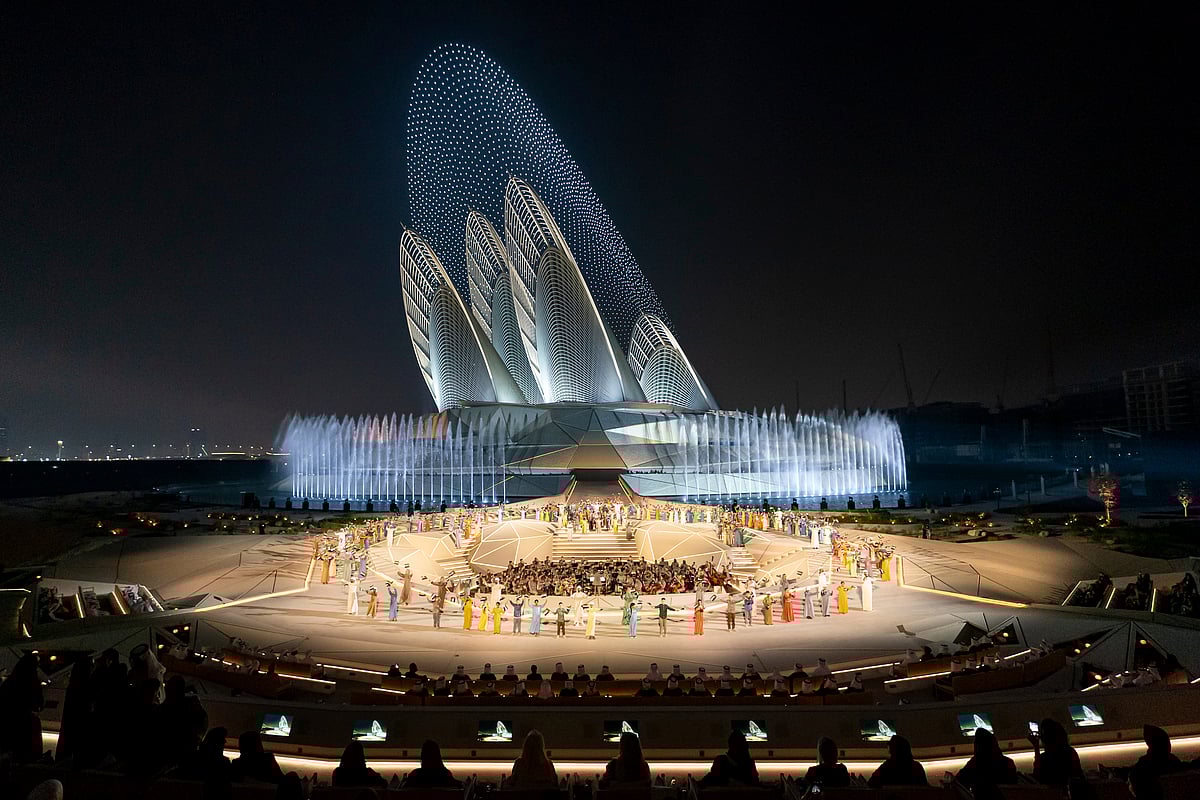
In the broader context of Saadiyat Island, a district increasingly defined by cultural landmarks, the opening set a benchmark. It demonstrated how lighting design can operate at an urban scale without sacrificing nuance. The event avoided the trap of excess that often accompanies large-scale national celebrations. There were no gratuitous color explosions, no relentless brightness. Instead, there was modulation, intentionality, and respect for context.
As the final notes of the anthem faded and the light sequences resolved into a calm architectural glow, the museum settled into its nighttime identity. What remained was not the memory of a spectacle, but the impression of a place that had been carefully introduced to the public through light. The Zayed National Museum did not announce itself loudly. It spoke clearly, confidently, and with an understanding that true cultural presence does not need to shout.
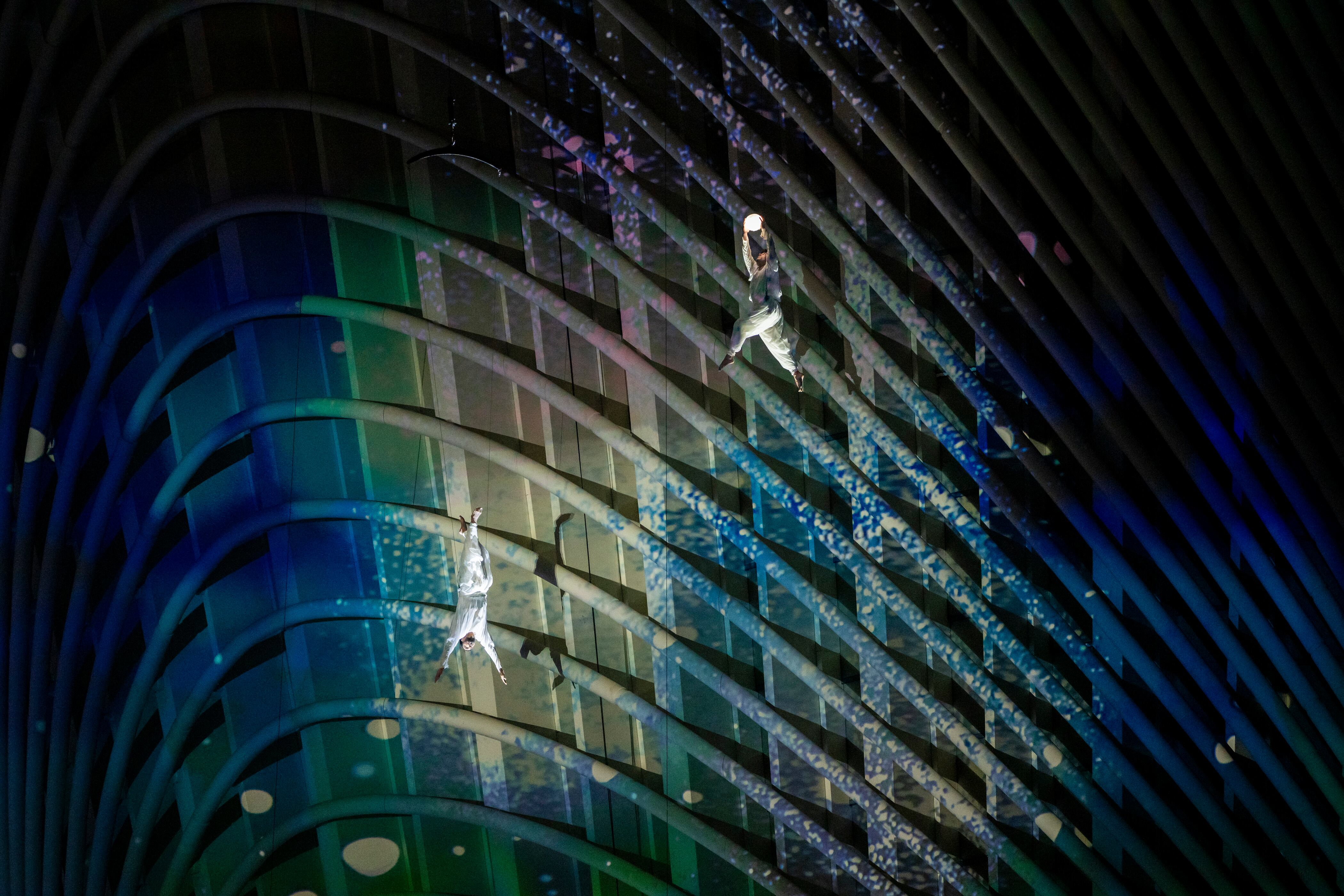
In this sense, the lighting design achieved something rare. It honored the past without freezing it, embraced technology without fetishizing it, and transformed a ceremonial opening into a meaningful spatial experience. Light became the medium through which architecture, music, and national narrative converged, offering a glimpse of how cultural institutions in the region might continue to evolve, not just as buildings, but as living, illuminated stories.